.jpg)

Tenancy deposit protection rules are designed to safeguard tenants' money while it is held as security during a tenancy. The deposit may cover unpaid rent, damage beyond normal wear and tear or other liabilities under the tenancy agreement.
Landlords must protect deposits through approved schemes and provide prescribed information, which means the details required by law about how the deposit is protected and returned.
This guide focuses on England, with a comparison of the rules in Wales, Scotland and Northern Ireland.
Tenancy Deposit Protection Rules Across the UK At a Glance
The rules apply to relevant types of tenancy and occupation contract, although legal exceptions exist. For example, a landlord who lives in the property and takes in a lodger does not generally need to protect the lodger's deposit through an approved tenancy deposit scheme.
A holding deposit, which is paid to reserve a property before a tenancy is agreed, is also different from a tenancy security deposit. Separate rules apply, including where the holding deposit is later used towards the tenancy deposit.
Deposit protection requirements differ across the four UK nations, particularly in their deadlines, deposit limits and enforcement procedures.
Requirement | England | Wales | Scotland | Northern Ireland |
|---|---|---|---|---|
Protect the deposit | Generally within 30 days of receipt | Within 30 days | Generally within 30 working days of tenancy commencement | Within 28 days |
Provide the required information | Within 30 days | Within 30 days | Generally within 30 working days of tenancy commencement, subject to the regulations | Within 35 days |
Maximum deposit | Five weeks' rent below £50,000 annual rent; six weeks at £50,000 or more | No equivalent general five- or six-week cap | Two months' rent | One month's rent (general cap) |
Approved schemes | DPS, MyDeposits, TDS | DPS, MyDeposits, TDS | Letting Protection Service Scotland, mydeposits Scotland, SafeDeposits Scotland | My Deposits Northern Ireland, Tenancy Deposit Scheme Northern Ireland |
Consequences of non-compliance | Court award of one to three times the deposit | Court award of one to three times the deposit | Tribunal can order payment of up to three times the deposit | Local council enforcement, fixed penalties and possible prosecution |
In Scotland, different deadlines can apply where a deposit is paid in agreed instalments. Certain exceptions also apply where tenancies end early.
In Wales, the person renting the property is called a contract-holder, and the rental agreement is generally known as an occupation contract. These terms form part of the Renting Homes (Wales) Act 2016 framework.
Landlords should follow the rules for the nation where their property is located rather than assuming the same deadlines apply throughout the UK.
What Changed in England on 1 May 2026?
From 1 May 2026, most existing assured shorthold tenancies became assured periodic tenancies under the Renters' Rights Act 2025.
An assured shorthold tenancy was a common type of private residential tenancy in England before the reforms. An assured periodic tenancy continues from one rental period to the next rather than ending after a fixed term.
Deposit protection obligations continue under the amended Housing Act 2004. An existing deposit does not generally need to be registered again solely because the tenancy converted to an assured periodic tenancy.
However, landlords should distinguish three separate matters:
Continued deposit protection: An existing deposit that was properly protected generally remains protected following the tenancy conversion.
Deposit prescribed information: Landlords must continue to comply with the rules requiring information about how the deposit is protected.
Renters' Rights Act Information Sheet: Most landlords with relevant existing written tenancy agreements were required to provide tenants with a separate government Information Sheet by 31 May 2026.
The Information Sheet explained the changes to tenancy rights and responsibilities. It was not a replacement for deposit prescribed information.
How Long Do You Have to Protect a Deposit in England?
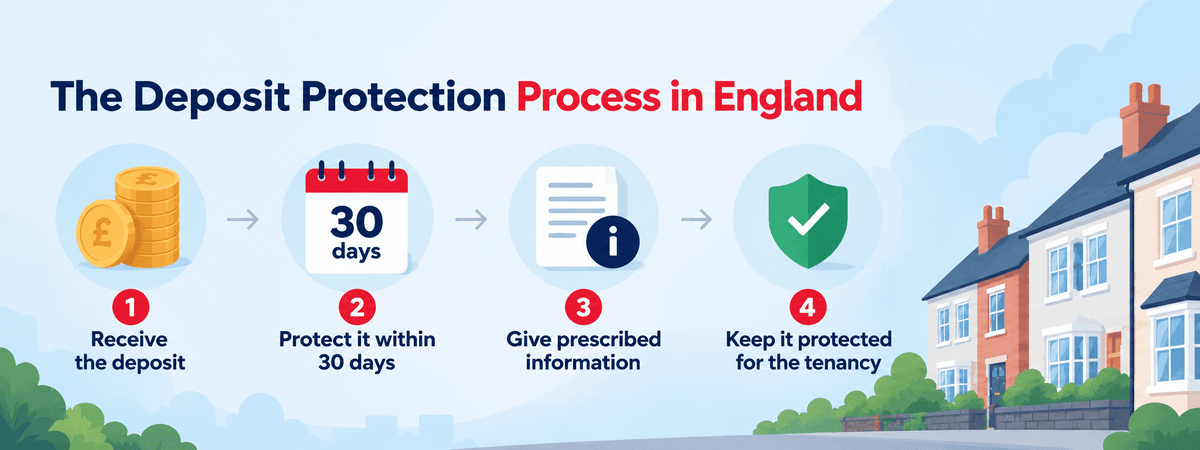
In England, landlords generally have 30 days from receiving a tenancy deposit to protect it through a government-approved scheme.
The deadline starts when the landlord or letting agent receives the money. It does not begin when the tenant moves into the property or when the tenancy agreement is signed.
Importantly, the date of receipt counts as day one.
Example
Suppose a landlord receives a tenancy deposit on 1 October 2026.
Day one: 1 October 2026
Day 30: 30 October 2026
Latest compliance date: 30 October 2026
The landlord must therefore meet the deposit protection requirements by 30 October 2026, not 31 October.
The 30-day period also applies to providing prescribed information, which is a separate legal requirement.
Landlords should not assume that registering a deposit after the deadline removes the consequences of late protection. Although late registration may help satisfy certain ongoing requirements, a tenant may still be able to claim compensation for the original breach.
What Is Prescribed Information?
Prescribed information is the information landlords must give tenants explaining how their deposit has been protected, who holds it and how it will be returned.
In England, landlords generally have 30 days from receiving the deposit to provide this information.
According to GOV.UK, it includes:
The address of the rented property.
The amount of the deposit received.
The name and contact details of the approved deposit protection scheme.
The landlord's name and contact details.
Details of anyone else who paid the deposit on the tenant's behalf.
How the deposit is protected and the arrangements for returning it.
The circumstances in which the landlord may keep part or all of the deposit.
What the tenant should do if they cannot contact the landlord at the end of the tenancy.
How disagreements about deductions or repayment will be resolved.
The information must also explain the scheme's dispute resolution service. This is a service that helps landlords and tenants resolve disagreements about deposit deductions without necessarily going to court.
Landlords must provide the prescribed information to the tenant and any relevant person, which can include a parent, guarantor or another person who paid the deposit on the tenant's behalf.
Simply registering a deposit does not automatically satisfy the prescribed information requirement. Landlords should make sure the complete required information has been provided and retain evidence that it was sent.
Which Tenancy Deposit Schemes Are Approved?
In England and Wales, landlords can choose from three government-approved tenancy deposit protection providers. These schemes safeguard tenants' deposits and provide procedures for returning money or resolving disagreements at the end of a tenancy.
The three approved providers are:
Deposit Protection Service (DPS): A government-approved provider offering custodial and insured deposit protection. Landlords can either transfer the deposit to the scheme for safekeeping or retain it under an insured arrangement.
MyDeposits: An approved deposit protection provider offering custodial and insured options. It also provides procedures for managing deposit repayments and resolving disputes between landlords and tenants.
Tenancy Deposit Scheme (TDS): Another government-approved provider offering custodial and insured protection. It also operates a dispute resolution service to help settle disagreements over deposit deductions.
These are three approved providers, not three different types of deposit protection. Each offers the two main protection methods.
Under a custodial scheme, the landlord transfers the deposit to the scheme, which holds the money during the tenancy.
This option is free. At the end of the tenancy, the deposit is returned according to the agreed repayment arrangements or the outcome of any dispute.
Under an insured scheme, the landlord or letting agent keeps the deposit but pays a fee to the scheme to insure it.
The landlord remains responsible for handling the money and returning the appropriate amount. If there is a dispute, the landlord or agent may need to transfer the disputed money to the scheme while the matter is resolved.
How Much Deposit Can a Landlord Charge in England?
For tenancies covered by the Tenant Fees Act 2019, the maximum tenancy security deposit depends on the annual rent.
Annual rent below £50,000: The maximum deposit is five weeks' rent.
Annual rent of £50,000 or more: The maximum deposit is six weeks' rent.
These are limits on the security deposit, not the amount of rent a landlord may charge.
To calculate the deposit limit, divide the annual rent by 52 to find one week's rent. Multiply that figure by five or six, depending on the applicable threshold.
Example
Suppose a landlord charges £12,000 annual rent.
One week's rent:
£12,000 ÷ 52 = £230.77
Maximum five-week deposit:
£12,000 ÷ 52 × 5 = £1,153.85
The landlord cannot normally require a larger security deposit for a tenancy covered by the five-week limit.
Threshold Example
The £50,000 threshold is important because it changes the number of weeks used to calculate the maximum deposit.
Annual rent of £49,999: Five weeks' rent, giving a maximum of approximately £4,807.60.
Annual rent of £50,000: Six weeks' rent, giving a maximum of approximately £5,769.23.
This means crossing the £50,000 threshold can significantly increase the maximum permitted deposit.
England's five- and six-week deposit limits do not automatically apply in Wales. Landlords with Welsh properties should follow the applicable Welsh legislation and guidance.
What Are the Penalties for Not Protecting a Deposit?
Failing to protect a deposit or provide the required information can result in financial penalties and difficulties recovering possession of a property.
In England and Wales, a court can order a landlord to pay compensation of between one and three times the deposit where the relevant statutory breach is established.
The court decides the amount within this range, taking account of the circumstances.
In Scotland, a tenant can apply to the First-tier Tribunal for Scotland, which is a body that resolves certain housing disputes. The tribunal can order a landlord to pay compensation of up to three times the deposit.
Northern Ireland has a different enforcement system. Local councils can take action for breaches, including fixed penalties and potential criminal prosecution.
Compensation is separate from any order requiring the landlord to return or protect the original deposit.
Example
Suppose a landlord receives a £1,000 tenancy deposit but fails to meet the relevant protection requirements.
If the court makes an award under the one-to-three-times rule, the compensation could be:
One times the deposit: £1,000
Two times the deposit: £2,000
Three times the deposit: £3,000
A £3,000 award is not automatic. The court determines the appropriate amount, and the landlord may face other financial consequences relating to the original deposit or court proceedings.
Protecting a deposit late does not necessarily remove liability for failing to meet the initial deadline.
What Happens If the Deposit Was Not Protected?
An unprotected deposit does not necessarily prevent a landlord from regaining possession permanently.
Depending on the circumstances, the relevant restriction may be removed where:
The deposit has been protected and the required information provided.
The deposit has been returned in full or with deductions agreed by the tenant.
Relevant court proceedings concerning deposit protection have been decided, settled or withdrawn.
However, correcting the position before seeking possession does not automatically eliminate financial liability for an earlier breach.
Landlords should therefore distinguish between meeting the conditions for a possession order and avoiding compensation for failing to protect a deposit on time.
The rules depend on the possession ground and the circumstances of the tenancy. Before starting proceedings, landlords should check GOV.UK's guidance on repossessing privately rented property after 1 May 2026.
When Must a Deposit Be Returned in England?
In England, landlords must return the agreed deposit amount within 10 days of reaching agreement with the tenant.
The deadline does not automatically begin on the day the tenancy ends. It starts when both parties agree how much should be returned.
A landlord may propose deductions for unpaid rent, damage beyond normal wear and tear or other liabilities covered by the tenancy agreement.
Fair wear and tear means the normal deterioration that occurs through everyday use of a property. It is different from damage caused by misuse or negligence.
Any proposed deduction should be supported by the tenancy agreement and appropriate evidence, such as photographs, inspection records or relevant invoices.
Example
A tenant has paid a £1,200 tenancy deposit.
At the end of the tenancy, the landlord proposes a £300 deduction for damage, which the tenant agrees to.
The remaining amount is:
£1,200 − £300 = £900
The landlord must return the agreed £900 within 10 days of the agreement.
Wales, Scotland and Northern Ireland: What to Remember
Although deposit protection exists across the UK, each nation has its own legal framework.
Wales
Under section 45 of the Renting Homes (Wales) Act 2016, landlords must generally protect deposits and provide the required information within 30 days for relevant occupation contracts.
The legislation refers to contract-holders rather than tenants. England's five- and six-week security deposit caps do not automatically apply.
Scotland
Scottish landlords generally have 30 working days from the beginning of a tenancy to protect the deposit.
The maximum tenancy deposit is two months' rent. Different timing rules can apply to agreed instalments, and certain statutory exceptions exist.
The approved schemes are Letting Protection Service Scotland, mydeposits Scotland and SafeDeposits Scotland.
Northern Ireland
Landlords generally have 28 days from receiving the deposit to protect it and 35 days to provide the required information.
The general maximum deposit is one month's rent, subject to applicable tenancy and transitional rules.
Northern Ireland uses its own approved schemes and local council enforcement procedures.
Landlords with properties outside England should consult the relevant Welsh Government, Scottish Government or indirect guidance before relying on English rules.
Is a Tenancy Deposit Taxable Income for Landlords?
A refundable tenancy deposit is not normally treated as taxable rental income when the landlord first receives it.
This is because the deposit remains money that may need to be returned to the tenant.
Under HMRC's cash basis accounting rules, the deposit generally becomes taxable income when the landlord becomes legally entitled to keep some or all of it.
The cash basis is a method of accounting that generally records rental income when money is received and expenses when they are paid.
HMRC Example
HMRC's Property Income Manual, PIM1094, includes an example involving a £1,100 tenancy deposit.
The landlord initially receives £1,100, but it is not treated as taxable property income because the money remains refundable.
When the tenancy ends, the landlord becomes legally entitled to retain £300 for an agreed liability. The remaining £800 is returned to the tenant.
Under the cash basis:
£1,100 received initially: Not included as taxable rental income at that point.
£300 subsequently retained: Included as a taxable receipt in the later tax year.
£800 returned: Not included as rental income.
This illustrates why the tax year in which a deposit is received may differ from the tax year in which a retained amount becomes taxable.
What If You Use the Accruals Basis?
The accruals basis generally recognises income when it is earned and expenses when they are incurred, rather than simply when money changes hands.
HMRC's guidance at PIM1052 explains that deposits are treated according to generally accepted accounting practice, which means recognised accounting rules.
Refundable deposits are normally deferred rather than immediately treated as income. Amounts retained when the tenancy ends are considered under the applicable accounting and tax rules.
There is also an important distinction between two types of deduction.
Deposit deduction: Money retained from a tenant's deposit because of an agreed or established liability.
Tax deduction: An expense that qualifies to be deducted when calculating taxable rental profits.
Keeping part of a tenant's deposit does not automatically mean the related expenditure is deductible for tax purposes.
Landlords unsure about the treatment of retained deposits should seek advice from their accountant.
Conclusion
Tenancy deposit protection in England requires landlords to protect deposits within the statutory deadline, provide the prescribed information and return the agreed amount on time. Failure to comply can result in compensation of one to three times the deposit and may affect a landlord's ability to regain possession.
Landlords should keep accurate records, monitor important deadlines and follow the requirements for the nation where their property is located. For questions about the tax treatment of retained deposits, professional accounting advice can help ensure the amounts are reported correctly.