.jpg&w=64&q=75)
.jpg)
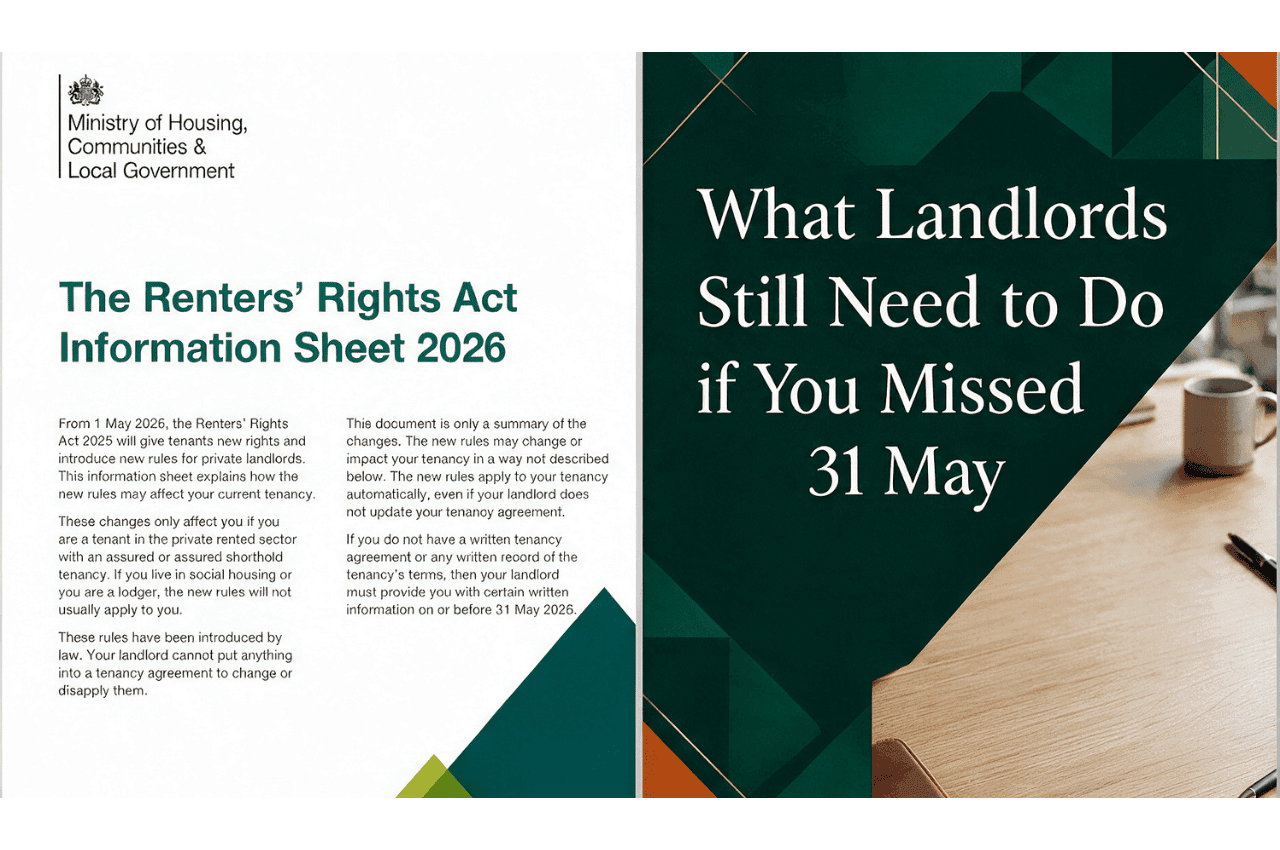
For many landlords, the key question is no longer what changed on 1 May 2026, but whether anything still needs to be done now. The Renters' Rights Act Information Sheet 2026 created a specific transitional obligation for certain existing tenancies, and missing the main deadline can leave an unresolved compliance issue rather than a closed administrative task.
That makes it important to identify exactly which tenancies were caught, whether any transitional possession rules changed the timing, and what steps can still be taken after the deadline. This guide works through those points so landlords can understand their position, correct any outstanding failure and reduce the risk of further enforcement action.
What Is the Renters' Rights Act Information Sheet 2026?
It is a document the government requires landlords to give to certain existing tenants, explaining how their tenancy changed under the Renters' Rights Act 2025. In legal terms it is "prescribed information"; information the law says must be given, in a set form.
The document that counts is The Renters' Rights Act Information Sheet 2026, in the version produced by the Secretary of State that has effect at the time. Before sending it, check GOV.UK and use the version currently in force rather than assuming a copy you saved earlier is still current.
It is a transitional document. It was designed for tenancies that already existed when the reforms began, so that tenants who had not signed anything new would still be told what had changed. It is not the same thing as the written statement of terms used for new tenancies.
Who Had to Be Given It, and by When?
The duty applied to an existing tenancy, an assured tenancy entered into before the relevant commencement date where that tenancy was wholly or partly in writing, subject to the private-sector commencement rules. For most private-sector assured tenancies, the relevant commencement date was 1 May 2026. Social housing assured tenancies are excluded from this Information Sheet requirement.
"Partly in writing" matters: an arrangement does not need a full signed agreement to fall within the duty.
Where the duty applied, the landlord had to give the tenant the prescribed information within one month of commencement. For the ordinary private-sector case that meant 31 May 2026.
GOV.UK says a copy should be given to every named tenant.
Some landlords with valid section 8 or section 21 notices served before 1 May 2026 could have had a later commencement date. Lodgers do not need to be given the Information Sheet. This guidance applies to England; the other UK nations have their own rules.
Situation | Did the Information Sheet duty apply? |
|---|---|
Private-sector assured tenancy to which the reforms applied from 1 May 2026, entered into before that date and wholly or partly in writing | Yes |
Wholly oral tenancy entered into before 1 May 2026 | Information Sheet: No. A separate written-information duty applies |
Assured tenancy entered into on or after 1 May 2026 | Information Sheet: No. A separate written-information duty applies |
Lodger (someone living with their landlord) | No |
Property outside England | Not covered by this guidance |
Did Your Deadline Fall Later Than 31 May?
Not every landlord was working to 31 May 2026.
Landlords who had served a valid section 8 or section 21 notice before 1 May 2026 which remained valid immediately before that date may have had a later commencement date for that tenancy. Where that was the case, and the saved notice later ceased to be valid, or possession proceedings concluded without possession being granted, the landlord generally had one month from that later date to provide the sheet.
Most landlords relying on a section 8 or section 21 notice served before 1 May 2026 had to start possession proceedings by 31 July 2026. If proceedings were started in time, the case could continue after that date until it was concluded.
Because these transitional rules can change the date on which the new tenancy rules started to apply, the one-month deadline for giving the Information Sheet may also have started later. Landlords should therefore check the dates of their notice and any possession proceedings before assuming that 31 May 2026 was their deadline.
A limited exception applied to certain section 8 rent-arrears cases where the tenant was protected by the Debt Respite Scheme, commonly known as Breathing Space. This scheme gives people with problem debt temporary protection from creditor action, which can delay certain possession steps for rent arrears. In those cases, the relevant possession deadline could be extended.
What Penalty Could Apply if You Missed the Deadline?
The maximum civil penalty is up to £7,000. It is a maximum, not a fixed fine, and not something that applies automatically.
Current government guidance gives £4,000 as the starting point for failure to give existing tenants the prescribed Schedule 6 information. That starting point may then be adjusted, including for aggravating and mitigating circumstances.
One of the things an authority may consider is how quickly the landlord put the non-compliance right. That is the practical reason not to leave it any longer.
There is also a further stage.
Where a relevant civil penalty has already been imposed and the failure continues beyond the statutory 28-day period, a continuing-breach offence can arise carrying the risk of prosecution, or an alternative civil penalty of up to £40,000. If the penalty is appealed within that period, the 28-day period runs by reference to the conclusion, withdrawal or abandonment of the appeal. That escalation follows an earlier penalty and a continuing failure. It is not something that happens simply because 31 May 2026 has passed.
What to Do Now if You Have Not Given It
|
|
|
|
Be clear about what sending it now does and does not achieve. If the prescribed document is validly provided, it remedies the continuing failure prospectively; it does not retrospectively meet the expired deadline.
Meaning that sending it late does not by itself erase the earlier breach or guarantee that a penalty will not be imposed, and it is not a guarantee against enforcement. What it does is address the continuing failure, and the speed of that remedy is one factor a council may weigh.
What Giving the Information Sheet Does Not Cover
Wholly oral tenancies entered into before 1 May 2026
These are a different case. The landlord needed to provide prescribed written tenancy information, rather than relying on the Information Sheet. For the ordinary case, that written information also had to be provided within one month of commencement, normally by 31 May 2026; saved-notice cases can change the applicable commencement date.
Tenancies entered into on or after 1 May 2026
For these, the normal requirement is to give prescribed written tenancy information under the new regime, normally before the tenancy is entered into. The transitional Information Sheet does not stand in place of it.
Student tenancies and the Ground 4A notice
Some landlords of existing student tenancies had a separate requirement to tell tenants in writing by 31 May 2026 if they wanted to preserve the option of using Ground 4A later to recover possession. The Renters’ Rights Act Information Sheet does not replace that separate notice. Ground 4A only applies where its specific student-tenancy conditions are met.
Your existing tenancy agreements
Existing written tenancy agreements do not need to be replaced or reissued merely because the Act changed the tenancy regime.
Legal Duty and Good Record-Keeping Practice
It helps to keep these two apart.
The statutory duty is to provide the prescribed information within the applicable period. GOV.UK guidance says a copy should be given to every named tenant.
Recommended practice not a legal requirement is to keep a dated record of what you sent, to whom, and by what method, stored so you can find it by property and by tenant. Where a council is weighing how promptly a landlord remedied a failure, your own records can provide evidence of when and how the non-compliance was remedied. They are not necessarily the only evidence, but they are the evidence most likely to be within your control.
Conclusion
Missing the 31 May 2026 deadline does not mean the issue should be ignored. The important step is to establish which deadline actually applied to the tenancy, correct any outstanding failure promptly and keep clear evidence of what was provided and when.
Landlords should also be careful not to treat the Information Sheet as a substitute for other obligations, including separate written tenancy information or Ground 4A notice requirements.
Where the position is unclear, particularly in transitional section 8 or section 21 cases, landlords should check their tenancy history against the official GOV.UK guidance on notices served before 1 May 2026 before taking further action.
Glossary Of Key Terms |
|---|
Assured tenancy: A type of residential tenancy covered by the Housing Act 1988. Under the Renters' Rights Act reforms, most private-sector assured tenancies in England are subject to the new tenancy regime. Existing tenancy: For these transitional rules, an assured tenancy that was entered into before the relevant Renters' Rights Act provisions started to apply to it. Commencement date: The date on which the relevant Renters' Rights Act rules started to apply to a tenancy. For most private-sector assured tenancies, this was 1 May 2026, although some transitional cases had a later date. Prescribed information: Information that legislation requires a landlord to provide in a particular form or containing specified details. For relevant existing written or partly written tenancies, this included the Renters' Rights Act Information Sheet 2026. Prescribed written tenancy information: The written information landlords must provide about the terms of an assured tenancy under the new regime. This is separate from the transitional Renters' Rights Act Information Sheet. Section 8 notice: A notice used by a landlord to begin the process of seeking possession of an assured tenancy using one or more statutory possession grounds. Section 21 notice: The former "no-fault" possession notice used under the previous assured shorthold tenancy regime. Transitional rules applied to some valid section 21 notices served before 1 May 2026. Ground 4A: A specific possession ground relating to certain student tenancies. For relevant existing tenancies, landlords also had to comply with a separate prior-notice requirement if they wanted to rely on this ground. Civil penalty: A financial penalty that a local housing authority may impose for certain breaches of the Renters' Rights Act requirements. For failure to provide the required Information Sheet, the maximum initial civil penalty can be up to £7,000. Aggravating and mitigating circumstances: Factors that can make a breach more or less serious when an authority decides the level of a civil penalty. For example, the authority may consider how quickly the landlord corrected the non-compliance. Debt Respite Scheme ("Breathing Space"): A statutory scheme that can temporarily restrict certain creditor actions for an individual in debt. It could affect the timing of some section 8 possession cases during the transitional period. Joint tenancy: A tenancy held by more than one tenant. GOV.UK says a copy of the Information Sheet should be given to every tenant named on the tenancy agreement. |
Sources |
|---|