.jpg)
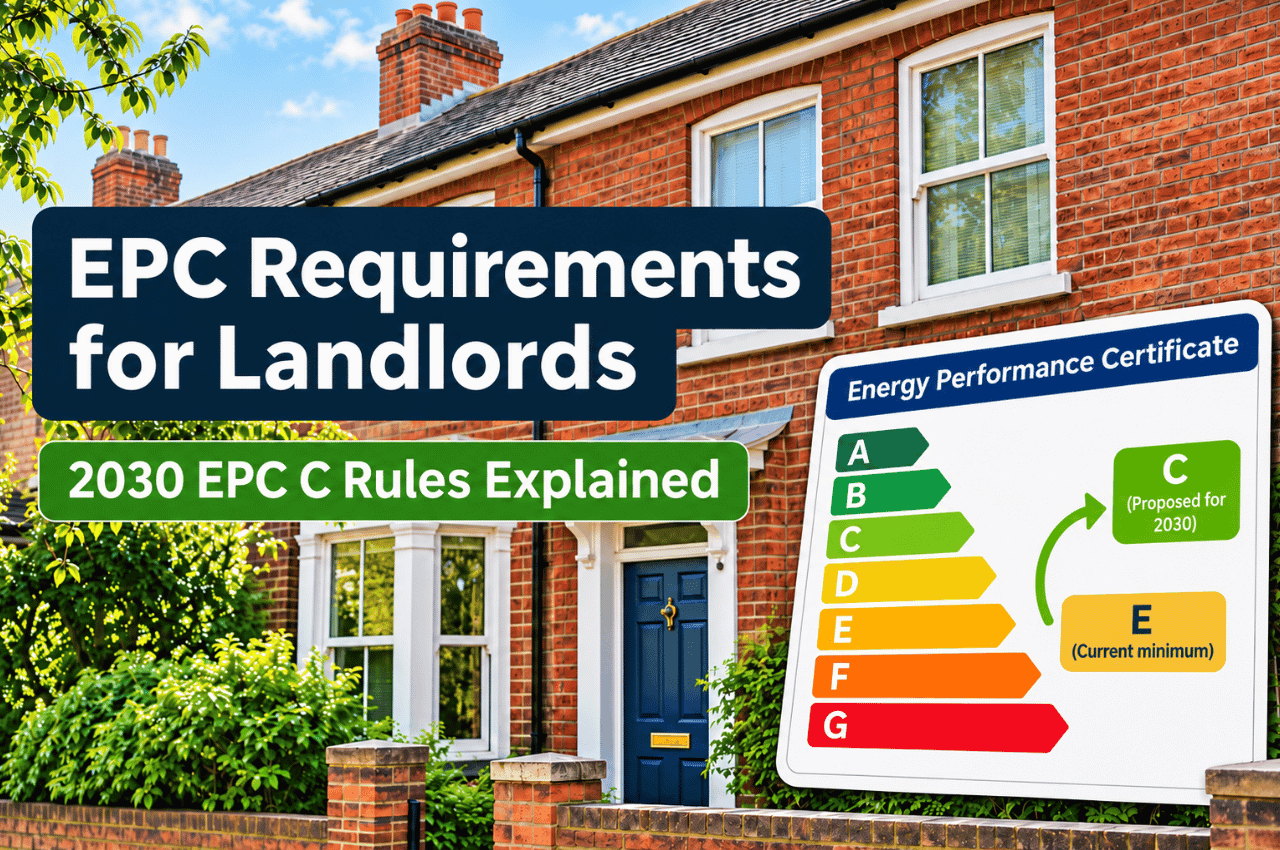
EPC requirements for landlords are changing, but not all at once. In January 2026, the government confirmed plans to raise energy efficiency standards for privately rented homes in England and Wales. It dropped the earlier 2028 deadline for new tenancies, introduced a single compliance date of 1 October 2030 and reduced the proposed spending cap from £15,000 to £10,000.
However, the higher standard is not yet law. This guide explains what landlords must do today, what the government intends to introduce by 2030 and how the proposed changes could affect improvement costs, exemptions and penalties.
What Are the Current EPC Requirements for Landlords?
Landlords in England and Wales need to understand two separate requirements: having an Energy Performance Certificate (EPC) when required and meeting the minimum energy efficiency rating for properties covered by Minimum Energy Efficiency Standards (MEES). These standards set the minimum energy efficiency level that certain privately rented properties must meet before they can legally be let.
Having and Sharing an EPC
An EPC shows a property's energy efficiency rating from A (most efficient) to G (least efficient), together with recommendations for improving its performance.
When a property is legally required to have an EPC, landlords generally must:
Before marketing: Have a valid EPC or commission one (arrange for an accredited assessor to prepare an EPC) before advertising the property. Under current rules, a commissioned EPC can be obtained within the permitted timeframe after marketing begins.
In advertisements: Display the property's energy rating in commercial property advertisements where it is available.
For prospective and incoming tenants: Make the EPC available at the required stage and provide a valid copy free of charge to the person who ultimately becomes the tenant.
Certain buildings and transactions are exempt from EPC requirements, so landlords should check whether the rules apply to their property.
These duties arise under the Energy Performance of Buildings (England and Wales) Regulations 2012.
Failure to comply with relevant EPC duties can result in a £200 penalty charge for a dwelling.
The Minimum EPC Rating for Rental Property
Under the current MEES rules, landlords generally cannot grant a new tenancy or continue letting a property rated F or G where the property and tenancy fall within the regulations, unless a valid exemption has been registered.
For residential properties, the minimum EPC E requirement has applied to all relevant existing tenancies since 1 April 2020. The rules principally cover certain assured tenancies, regulated tenancies and domestic agricultural tenancies where the property is legally required to have an EPC.
If a property is covered and rated F or G, the landlord must improve it to at least E or register a valid exemption.
The current cost cap is £3,500 including VAT meaning that residential landlords are generally not required to spend more than £3,500, including VAT, of their own money on qualifying energy efficiency improvements. Any qualifying improvements made since 1 October 2017 can count towards this limit. If the property still cannot achieve EPC E after all relevant improvements within the spending cap have been completed, the landlord may qualify for a registered exemption.
Official guidance: Domestic Private Rented Property: Minimum Energy Efficiency Standard
What Changes in 2030: EPC C Explained
On 21 January 2026, the government published its response to the consultation on improving the energy performance of privately rented homes.
It confirmed a proposed minimum energy efficiency standard equivalent to EPC C by 1 October 2030 for private rented homes in England and Wales that fall within the regulations.
The same deadline will apply to new and existing tenancies, replacing the earlier proposal for a separate 2028 deadline for new tenancies.
The government intends to introduce new primary legislation and amend the existing MEES regulations to implement these changes. Until the necessary legislation is made and comes into force, landlords remain subject to the current EPC E requirements.
What EPC C Will Mean Under the New Metrics
The planned standard will not rely solely on the existing A to G Energy Efficiency Rating.
Reformed EPCs will display four headline metrics:
Energy cost: The estimated cost associated with a property's energy use.
Fabric performance: How effectively the building retains heat through insulation, windows and other structural features.
Heating system: The efficiency and environmental impact of the property's heating system.
Smart readiness: The property's ability to use, manage and respond flexibly to energy technologies.
Under the government's planned rules, landlords will generally need to achieve:
Band C on the fabric performance metric; and
Band C on either the heating system metric or smart readiness metric.
Landlords will be able to choose which secondary metric to meet.
A property may also comply through a valid registered exemption or the transitional arrangements for qualifying existing EPC C certificates.
The government intends landlords to address fabric performance first, followed by their chosen secondary metric.
The detailed assessment methodology and the thresholds needed to achieve each new band are subject to the final EPC reforms.
The government announced in March 2026 that the introduction of reformed EPCs would move to the second half of 2027.
See the government's Home Energy Model consultation update.
EPC Changes: Key Dates and Deadlines
Date | Requirement or Development |
|---|---|
1 April 2020 | EPC E became the minimum for all existing tenancies covered by domestic MEES. |
1 October 2025 | Qualifying improvement expenditure from this date can count towards the proposed £10,000 cap. |
21 January 2026 | Government confirmed its policy decisions for the higher 2030 standard. |
March 2026 | Launch of reformed EPCs moved to the second half of 2027. |
2027 | Government's stated target for introducing the new MEES regulations, subject to Parliamentary approval. |
Second half of 2027 | Reformed EPCs expected to become available. |
Before 1 October 2029 | Existing-style EPCs rated C or above must be lodged to qualify for the planned transitional arrangement. |
1 October 2030 | Proposed compliance deadline for all relevant new and existing tenancies. |
The dates relating to future requirements reflect government policy rather than legislation already in force.
Current EPC Rules vs the Proposed 2030 Standard
Requirement | Current Rules | Planned 2030 Rules |
|---|---|---|
Minimum standard | EPC E | C on fabric performance plus C on heating system or smart readiness |
Relevant tenancies | New and existing | New and existing |
Spending cap | £3,500 including VAT | £10,000 per property |
Lower-value properties | General £3,500 cap | Lower cap equal to 10% of value where property is worth less than £100,000 |
Qualifying expenditure dates | From 1 October 2017 | From 1 October 2025 |
Cost-related exemptions | Generally, five years | Proposed ten-year validity for relevant cost and property value exemptions |
Maximum MEES penalty | £5,000 per property | £30,000 per property, per breach |
Legal status | In force | Subject to further legislation |
The future requirements and exemptions will depend on the final regulations.
The £10,000 Cost Cap: What Counts?
Under the government's planned 2030 rules, landlords will generally be required to invest up to £10,000 per property in qualifying energy efficiency improvements.
The cap applies to the total qualifying expenditure needed to meet both the fabric performance standard and the chosen secondary metric.
For example, if qualifying fabric improvements cost £6,000, the landlord would have up to £4,000 remaining within the cap for relevant measures addressing the second metric.
According to the January 2026 government response, expenditure that may count includes:
Qualifying energy efficiency improvements installed from 1 October 2025.
Relevant measures recommended by an EPC or other approved assessment.
The cost of EPC assessments required before and after improvements.
Certain specialist retrofit advice, subject to limits to be confirmed in legislation.
Eligible third-party funding, including relevant government grants.
Funding from the Boiler Upgrade Scheme will not count towards the cap.
For the period from 1 October 2025 to 30 September 2029, expenditure on improvements recommended by existing-style EPCs can count, except expenditure on installing fossil fuel heating systems.
What Happens if Improvements Cost More Than £10,000?
Under the government's planned cost cap exemption, landlords could register an exemption where:
They have already incurred qualifying expenditure up to the applicable cap and the property remains below the required standard; or
The next cheapest qualifying improvement would take the total relevant expenditure above the cap.
The planned exemption will generally last 10 years.
The government has also proposed a lower maximum investment requirement for properties worth less than £100,000. For these properties, the cap will be 10% of the property's value, where that is lower than £10,000.
The government estimates that the average expenditure required to meet the higher standard will be approximately £5,400 per property.
Landlords should retain EPCs, invoices, quotations, grant records and evidence of completed improvements to support future compliance and exemption applications.
Source: Improving the Energy Performance of Privately Rented Homes: Government Response.
EPC Exemptions and How to Register One
An EPC exemption allows a landlord to continue letting a property covered by MEES even though it does not meet the required minimum rating, provided the relevant legal conditions are satisfied.
Current exemptions must be registered on the PRS Exemptions Register and take effect from the date of registration.
Exemptions Available Today
Exemption | When It May Apply | Duration |
|---|---|---|
High cost | Even the cheapest recommended improvement costs more than £3,500 including VAT. | 5 years |
All relevant improvements made | The landlord has completed the relevant improvements within the cost cap, or none can be made, but the property remains below E. | 5 years |
Wall insulation | Relevant cavity, external or internal wall insulation would negatively affect the building's fabric or structure, supported by expert advice. | 5 years |
Third-party consent | Required consent cannot be obtained despite reasonable efforts or is subject to unreasonable conditions. | Up to 5 years, or until the relevant tenancy ends or is assigned where tenant consent is the issue |
Property devaluation | An independent qualified surveyor confirms that relevant improvements would reduce the property's market value by more than 5%. | 5 years |
Temporary new landlord | A person becomes a landlord in specified circumstances and qualifies for temporary relief. | 6 months |
Each exemption has specific conditions and evidence requirements.
For example, a high-cost exemption requires three quotations from qualified installers demonstrating that the cheapest recommended improvement would exceed £3,500.
A wall insulation exemption requires a written opinion from a relevant expert. A property devaluation exemption requires a report from an independent surveyor registered with the Royal Institution of Chartered Surveyors.
How to Register an Exemption
To register an exemption:
Confirm that the property and tenancy fall within MEES.
Identify which exemption applies and check the relevant conditions.
Gather the required evidence, including EPCs, quotations, expert reports or correspondence.
Register the exemption through the PRS Exemptions Register.
Record the exemption's expiry date and review the property's position before it ends.
When an exemption expires, the landlord must reassess the property and either comply with the required standard or register a further exemption where eligible.
Exemptions do not automatically transfer when a property is sold. A new landlord must establish their own compliance position.
Exemptions Under the 2030 Rules
The government intends to revise the current exemption framework alongside the higher standard.
The planned arrangements include:
Cost cap exemption: Where the relevant spending cap has been reached or the next cheapest qualifying improvement would exceed it.
Property value adjustment exemption: A reduced spending limit for properties valued below £100,000.
All relevant improvements made exemption: Where no further relevant improvements can be made, rather than simply because the spending cap has been reached.
Negative impacts exemption: Where qualifying improvements would adversely affect the property, expanding the existing approach to wall insulation and devaluation.
Third-party consent exemption: Continuing protection where required consent cannot be obtained.
Temporary new landlord exemption: A six-month period in qualifying circumstances.
High cost exemption: Continuing provision where relevant improvement costs meet the exemption criteria.
The cost cap, property value adjustment and negative impacts exemptions are planned to last 10 years. The all-relevant improvements made exemption is expected to last five years.
These remain proposed arrangements until the relevant regulations are finalised.
Will an EPC C Obtained Before 2029 Still Count?
Yes, under the planned transitional arrangements.
A current-style EPC showing C or above, lodged before 1 October 2029, will be recognised as compliant with the higher standard until the certificate expires or is replaced.
For example, a qualifying EPC lodged in March 2029 could remain valid until March 2039.
However, if the certificate is replaced before its expiry, the transitional treatment of the earlier certificate will end.
Landlords considering improvements before October 2029 should therefore think carefully about the timing of their EPC assessments.
Penalties for Letting Below the Minimum
Local authorities are responsible for enforcing the current MEES requirements.
The maximum financial penalties are:
Breach | Maximum Penalty |
|---|---|
Letting a non-compliant property for less than three months | £2,000 |
Letting a non-compliant property for three months or more | £4,000 |
Registering false or misleading information on the Exemptions Register | £1,000 |
Failing to comply with a compliance notice | £2,000 |
The combined financial penalties under the current MEES regime cannot exceed £5,000 per property.
Local authorities may also publish details of breaches on a public register.
Separately, breaches of certain EPC marketing and provision requirements can result in a £200 penalty charge for a dwelling.
What Will the Penalties Be From 2030?
The government intends to increase the maximum MEES penalty to £30,000 per property, per breach.
The proposed higher penalty would cover failures to meet the new standard without a valid exemption and relevant breaches involving false or misleading exemption information.
The £30,000 maximum is not currently in force and will require legislation.
Can You Claim EPC Improvement Costs Against Tax?
Whether landlords can deduct EPC improvement costs from rental profits depends on the nature of the work.
HMRC distinguishes between revenue expenditure, such as qualifying repairs, and capital expenditure, such as substantial improvements or additions to a property.
Repairs that restore an existing part of a property, including replacements using modern equivalent materials, may qualify as deductible revenue expenditure.
For example, HMRC's Property Income Manual PIM2030 explains that replacing single glazing with double glazing can qualify as a repair where the replacement performs broadly the same function.
In contrast, installing an entirely new feature, such as insulation where none previously existed, may be capital expenditure depending on the circumstances.
Capital improvements are generally not deductible when calculating rental business profits. However, qualifying enhancement expenditure may be deductible when calculating Capital Gains Tax on a future disposal.
Under section 38 of the Taxation of Chargeable Gains Act 1992, the expenditure must satisfy the relevant conditions, including being reflected in the property's state or nature at disposal and not having been deducted elsewhere.
Landlords should retain invoices and records describing the work carried out, particularly where a project contains both repairs and improvements.
Do the Same EPC Rules Apply in Scotland and Northern Ireland?
No. The EPC and minimum energy efficiency frameworks differ across the UK.
Scotland: The Scottish Government has consulted on a separate minimum energy efficiency standard for privately rented homes based on the proposed Heat Retention Rating. Its consultation proposed band C for new tenancies from 2028 and all relevant privately rented homes by the end of 2033.
These are Scottish proposals rather than the England and Wales requirements discussed above. The Scottish Government published an analysis of consultation responses on 6 October 2026.
See Scottish Government: Private Rented Sector Minimum Energy Efficiency Standard Consultation Analysis.
Northern Ireland: Separate EPC legislation applies. Landlords should follow Northern Ireland's own EPC rules rather than assuming the England and Wales MEES requirements apply.
The proposed EPC C standard announced by the UK Government in January 2026 is specifically for England and Wales.
Worked Examples
The following examples illustrate the existing rules and the government's planned 2030 requirements. Future exemptions and compliance arrangements remain subject to legislation.
Example 1: Reaching EPC C Before the 2029 Deadline
Priya lets a semi-detached house with an EPC rating of D.
In 2027, she improves the loft insulation and adds draught proofing. A new EPC lodged on 15 March 2028 confirms that the property has achieved C under the existing Energy Efficiency Rating.
Because the EPC was lodged before 1 October 2029 and shows C, the property would qualify for the government's planned transitional arrangement.
The certificate could continue to demonstrate compliance with the higher standard until March 2038, provided it remains valid and is not replaced earlier.
Example 2: Reaching the £10,000 Cost Cap
Tom lets a terraced property valued at £220,000.
He undertakes the following qualifying improvements and assessments:
Item | Cost |
|---|---|
Loft insulation installed in November 2025 | £1,200 |
EPC assessment before further work | £150 |
Cavity wall insulation | £3,400 |
Underfloor insulation | £4,500 |
EPC assessment after improvements | £150 |
Total qualifying expenditure | £9,400 |
The property now meets the proposed fabric performance standard but remains below the required heating system and smart readiness standards.
Assume the next cheapest qualifying improvement needed to meet the secondary standard costs £3,000.
Installing it would increase Tom's qualifying expenditure to:
£9,400 + £3,000 = £12,400
Under the government's planned rules, Tom could qualify for a cost cap exemption because the next cheapest qualifying improvement would take the total above £10,000.
The planned exemption would last 10 years, subject to the final eligibility and evidence requirements.
Example 3: A Lower-Value Flat
Aisha owns a privately rented flat valued at £75,000.
Under the proposed property value adjustment, the maximum required expenditure would be 10% of its value because the flat is worth less than £100,000.
£75,000 × 10% = £7,500
Aisha's proposed expenditure cap would therefore be £7,500 rather than £10,000.
If the property remained below the future standard after the applicable qualifying expenditure had been incurred, or the next cheapest relevant measure exceeded the remaining cap, she could potentially register a property value adjustment exemption.
The government intends this exemption to last 10 years.
Conclusion
For now, landlords in England and Wales must comply with the existing EPC E minimum where their property and tenancy fall within MEES, unless a valid exemption applies. The government's planned EPC C standard from 1 October 2030 will introduce higher efficiency requirements, a £10,000 expenditure cap and substantially increased penalties, but further legislation is needed.
Landlords should review their current EPC ratings, consider whether improvements could achieve C before October 2029 and retain clear records of qualifying expenditure from October 2025. Early planning can help avoid unnecessary costs and make future compliance easier to demonstrate.