.jpg)
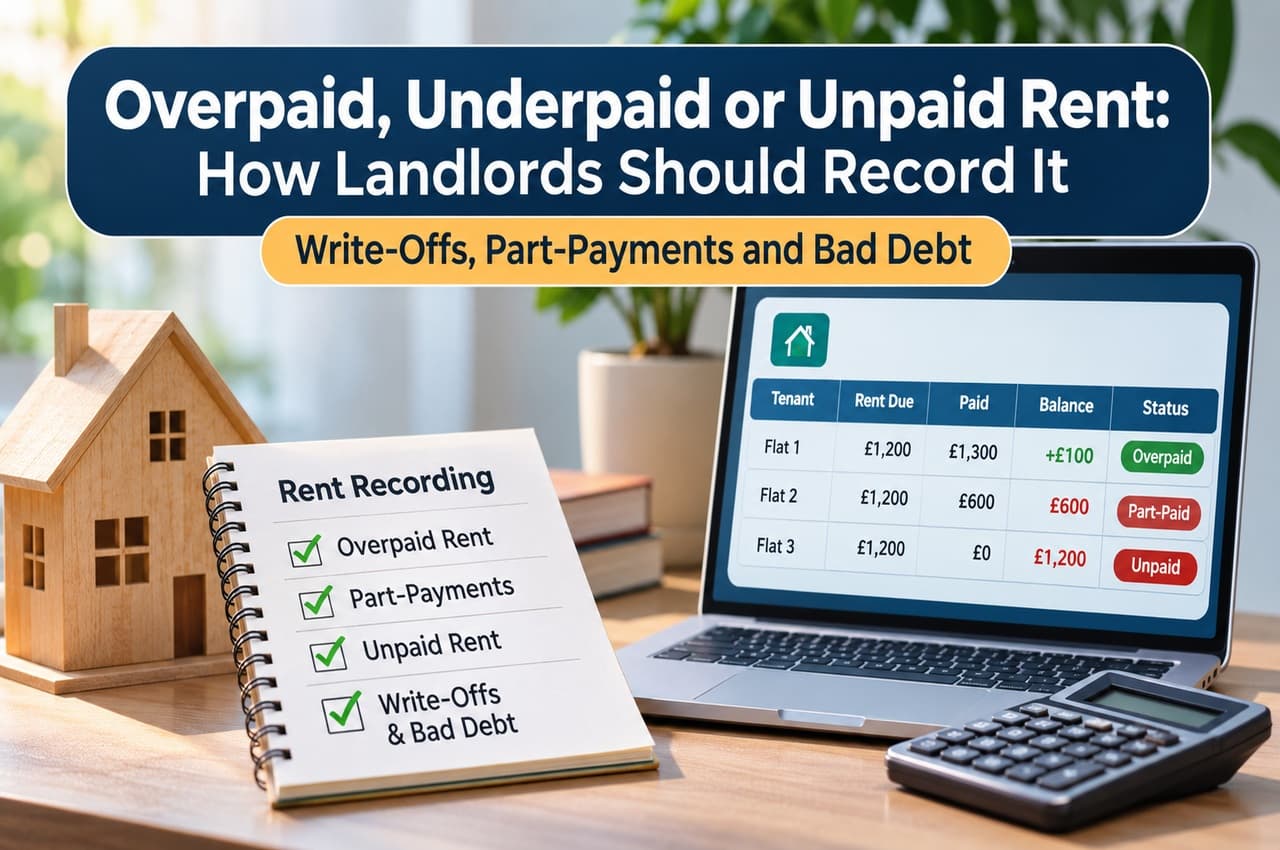
Rent rarely arrives exactly as invoiced. Tenants round up, pay in instalments, pay a week late or stop paying altogether. Letting agents send net amounts that do not match any single rent charge. Each of these leaves a gap between what was due and what reached your bank, and that gap has to be recorded correctly.
It matters more now that Making Tax Digital (MTD) for Income Tax has started. Landlords with qualifying income over £50,000 have had to keep digital records and send quarterly updates since 6 April 2026, and the thresholds fall to £30,000 from April 2027 and £20,000 from April 2028. This guide explains how to record overpaid, part-paid and unpaid rent, when a landlord can write off unpaid rent, what is taxable in each case, and what it means for your digital records.
Start With Your Accounting Basis: It Decides the Tax Answer
Before you record anything unusual, check which basis you use to work out your rental profit. The record-keeping is similar either way, but the tax result is very different.
The cash basis counts rent when you receive it and costs when you pay them. Since 2017/18 it has been the default for individual landlords. You must use the accruals basis instead if, for example:
the property business is run by a company, LLP or trust
your cash receipts for the year are more than £150,000 (reduced proportionately for part of a year)
you jointly own property with your spouse or civil partner and they use the accruals basis for that income
you choose to opt out of the cash basis on your tax return
(Source: ITTOIA 2005 s271A and GOV.UK: Work out your rental income.)
The accruals basis (also called traditional accounting or GAAP) counts rent for the period the tenant occupies the property, whether or not it has been paid (HMRC PIM1101).
Situation | Cash basis | Accruals basis |
|---|---|---|
Tenant overpays and you keep it for next month's rent | Taxable when received | Taxable in the period it relates to |
Tenant part-pays | Only the amount received is income | Full rent earned is income; unpaid balance is recorded as a debt |
Rent never paid | Not taxable, so no bad debt deduction | Income when earned; bad or doubtful debts may be deductible |
Arrears paid later | Income when received | Not taxed again unless previously deducted as a bad debt |
Deposit kept for damage or arrears | Income when legally entitled to keep it | Recognised when retained, without double-counting rent already recorded |
Whichever basis you use, keep a running balance for each tenant. Your basis changes the tax, not the need to know who owes what.
Overpaid Rent: How to Record It and Credit the Tenant
Overpayments are common and usually innocent: a duplicated standing order, a tenant paying the old rent after a decrease, a housing benefit or Universal Credit payment landing alongside the tenant's own payment, or a tenant paying ahead before going abroad.
Find Out Why It Was Overpaid
Check the tenancy agreement and the tenant's payment history before deciding what to do. The reason affects whether the money is rent paid early or a mistake that should go back.
Option 1: Hold It as Credit on the Tenant's Account
If the tenant agrees, keep the extra as credit and apply it to the next rent due. Record the full receipt against the tenant, allocate the amount due to the current rent, and leave the remainder as an unapplied credit. Confirm the arrangement to the tenant in writing so both sides know the balance.
Option 2: Refund It
If the money was paid in error, or the tenant asks for it back, refund it promptly. Record the refund against the same tenant credit, not as an expense, so the two entries cancel out.
How Overpaid Rent Is Taxed
Under the cash basis, rent paid in advance is taxed in the tax year you receive it, even if it covers a later month. If you keep an overpayment towards future rent, it is normally taxable when received. However, if the tenant paid extra by mistake and you refund it, the amount is not rental income. If the payment and refund fall in different tax years, check the correct treatment with your accountant.
Under the accruals basis, rent is taxed in the period it relates to, regardless of when it is received. For example, rent paid in March for April is treated as April's income.
Do Not Confuse an Overpayment With a Deposit
A tenancy deposit is different from rent. Under the cash basis, it only becomes taxable income when you have the legal right to keep some or all of it. Only the amount you are entitled to keep is taxable.
Do not record an overpayment directly as rental income or "other income". Keep it as a separate credit until you confirm whether it should be refunded or used towards future rent.
Part-Payments: How to Record and Allocate Them
Good part payment rent record keeping comes down to two things: showing exactly what arrived, and showing exactly what is still owed.
Record What Was Actually Received
Record the amount and the date the money arrived, and allocate it to the rent charge it relates to. Leave the rest of that rent showing as outstanding. HMRC expects digital records to show the amount, the date received and the category, and to be created as close to the transaction as possible.
Which Period Does a Part-Payment Cover?
If the tenant tells you which rent the payment is for, follow that. If they do not, apply payments consistently, commonly to the oldest unpaid rent first, and show the allocation on the tenant's rent statement. A clear, consistent statement is what you will need if the arrears ever end up in a dispute or in court.
One Payment Covering Several Months or Units
A tenant clearing two months of arrears, or an agent paying for several units in one transfer, should be split so that each rent period or unit shows exactly what was paid against it. This keeps your arrears figures right property by property.
Agent Remittances
Letting agents often deduct their fees before transferring rent to landlords. Record the full rent collected and the agent's fees separately, rather than just the amount received in your bank. HMRC's MTD guidance requires landlords to record gross income and expenses separately. Under the cash basis, rent is taxable when the agent receives it, not when they transfer it to you.
Late Payment Charges
You can only charge for late rent if the tenancy allows it. In England, for most assured shorthold tenancies, a late rent charge can only apply once rent is 14 days overdue and is capped at interest of 3% above the Bank of England base rate (Tenant Fees Act 2019, Sch 1 para 4). Different rules apply in Wales, Scotland and Northern Ireland.
Unpaid Rent and Bad Debt: When and How to Write Off Rent Arrears
Under the cash basis, unpaid rent is not included in your taxable income, so you cannot claim a bad debt deduction. HMRC confirms that landlords using the cash basis do not need to account for bad or doubtful debts.
If you believe the rent will not be recovered, you can mark it as written off in your records. This keeps your accounts accurate without creating a tax-deductible expense. Keep the payment history in case the debt is recovered later.
On the Accruals Basis: The Conditions for a Bad Debt Deduction
Under the accruals basis, rent is recorded as income when earned, even if the tenant has not paid. If the rent later becomes unlikely to be recovered, you may claim a bad or doubtful debt deduction under ITTOIA 2005, sections 35 and 272.
HMRC's guidance at PIM2072 sets out the main conditions:
The debt must be specific. General provisions for unpaid rent are not normally allowed, although limited exceptions exist for large portfolios with reliable records.
Reasonable recovery steps are required. You must have taken all reasonable steps to recover the unpaid rent.
Only the amount unlikely to be recovered is deductible. Deduct any amount you reasonably expect to recover, including from deposits or guarantors.
Claim relief in the correct tax year. The deduction belongs to the year the debt becomes bad or doubtful.
Late payment alone is not enough. There must be a genuine reason to believe the tenant will not pay.
Keep evidence of your recovery attempts, including rent statements, payment reminders, correspondence, court documents and information showing the tenant cannot pay or be traced.
Writing Off Arrears Is Not the Same as Reducing the Rent
If you agree before rent falls due to reduce or waive it, through a genuine change to the tenancy terms, that rent is no longer taxable. Simply giving a tenant more time to pay does not remove the tax charge. If you let a relative off for personal reasons, that is not a bad debt and cannot be deducted (PIM2072).
If the Tenant Pays Later
On the cash basis, a late payment is simply income when you receive it. On the accruals basis, an amount you previously deducted as a bad debt becomes a taxable receipt when it is recovered (PIM2072). If you have stopped letting by then, it is taxed as a post-cessation receipt (PIM3000).
Using the Deposit Against Arrears
If you keep part of a deposit to cover unpaid rent, the amount kept becomes income when you are entitled to keep it. Record it against the tenant's arrears so the balance reduces correctly.
How RentalBux Handles Overpayments, Part-Payments and Write-Offs
RentalBux lets you match each bank receipt to the tenant’s rent request in Banking, so differences are picked up as you reconcile rather than at year end.
Matching a Receipt to Rent Requests
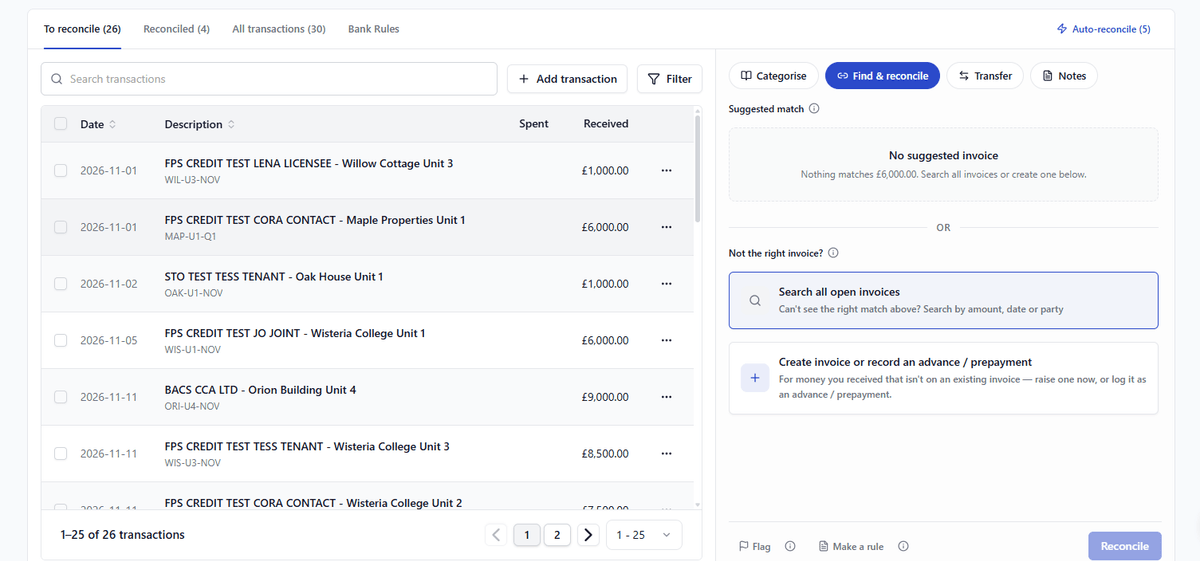
In Banking > Reconcile, select the receipt and open Find & reconcile. RentalBux suggests a rent request when the amount matches exactly. When it does not, as with most overpayments and part-payments, choose Search all open invoices and pick the rent request yourself.
Once you tick one or more rent requests, an Allocate this payment panel shows how much of the receipt settles each one. RentalBux then compares the two totals (Received, Record total and the difference) and tells you straight away if the tenant has paid too much or too little.
When the Tenant Overpays
RentalBux shows Overpayment detected with the surplus amount and asks how it should be handled:
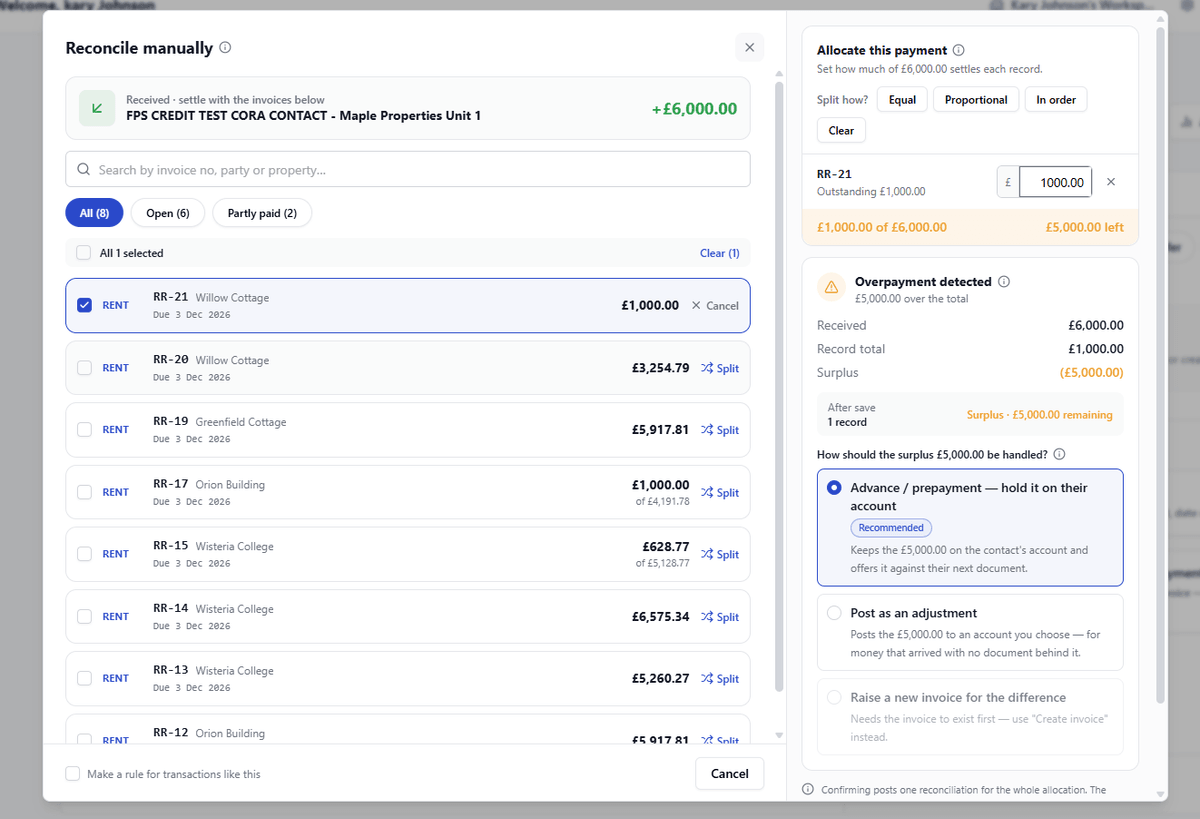
Advance / prepayment (recommended): keeps the surplus on the tenant’s account as credit. It is not posted as rental income at this point.
Post as an adjustment: sends the surplus to a ledger you choose, through a short adjustment journal. This is meant for money that arrived with no rent request behind it.
Raise a new invoice for the difference: shown as an option, but it needs the rent request to exist first. Otherwise, use Create invoice or record an advance / prepayment from the reconcile panel.
When the Tenant Underpays
RentalBux shows Underpayment detected with the shortfall and asks how it should be handled:
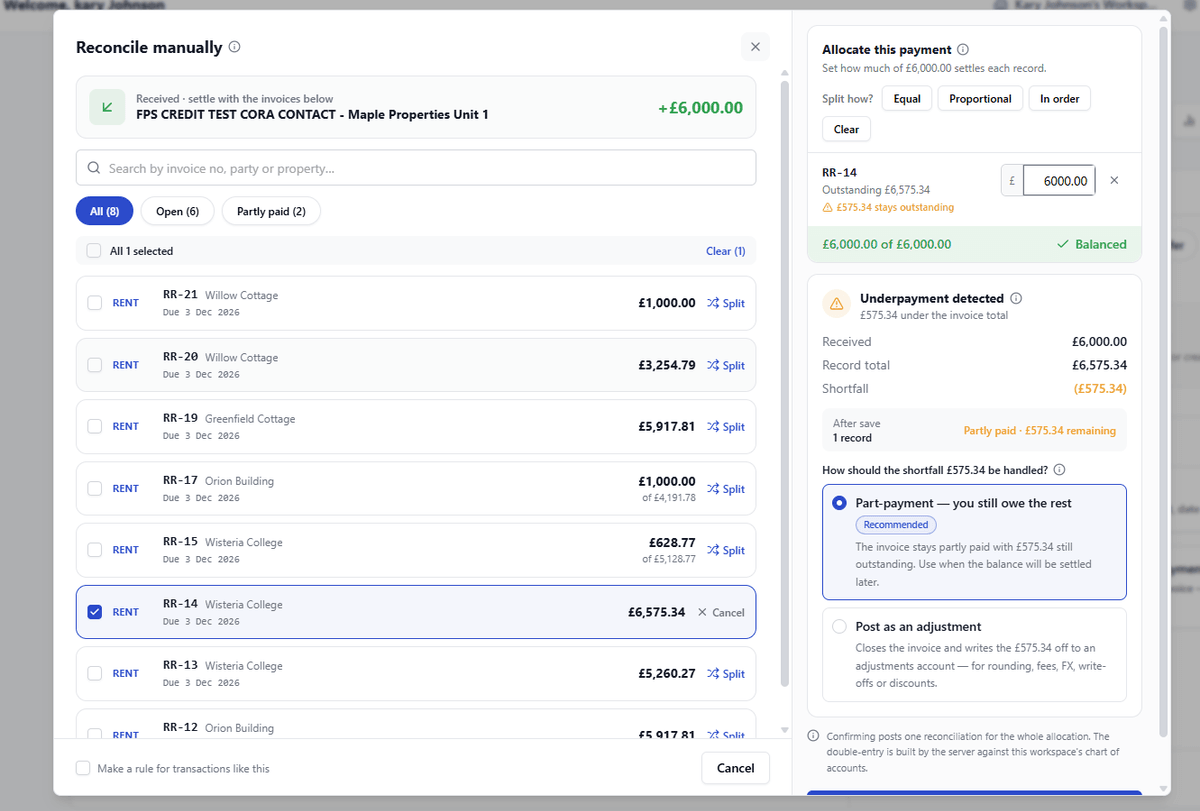
Part-payment (recommended): records the amount received and leaves the rest owing. The rent request is marked Part-paid and shows the outstanding balance, so the next payment can be matched against it.
Post as an adjustment: writes the shortfall off to a ledger you choose, such as Bad Debts, through a write-off journal. RentalBux describes this option as suitable for rounding, fees, foreign exchange differences, write-offs or discounts. Only the cash received is recorded as a payment from the tenant.
One Payment Covering Several Rent Requests
Tick every rent request the payment covers, then choose how to split it under Split how?:
Equal: the same amount against each request.
Proportional: in proportion to the amount of each request.
In order: clears each request in full, in the order you selected them, until the money runs out.
You can also type your own amount against each request. If the total still falls short or exceeds the requests, the same underpayment or overpayment options appear. Confirming posts one reconciliation for the whole allocation.
Conclusion
Three rules cover almost every awkward rent payment. Record what the tenant actually paid and when. Keep the tenant's balance visible until it is collected, refunded or written off. Let your accounting basis decide the tax: on the cash basis, unpaid rent was never taxed so there is no bad debt to claim; on the accruals basis, a specific bad debt is deductible once you have tried to recover it, in the year it goes bad.