.jpg&w=64&q=75)
.jpg)



If you are a landlord whose agent sends a monthly statement showing the full rent, then deducts commission, letting fees, and sometimes maintenance before paying you the balance, this guide is for you.
Getting letting agent statement right matters more now that MTD requires digital records and quarterly updates. The temptation is to log whatever was received in the bank account and move on. That single habit understates your income, hides your allowable expenses, and can distort every quarterly update you file under MTD.
This guide covers what an agent statement contains, how to split a net payment into the correct lines, and how gross versus net reporting works for MTD.
Why Is the Bank Figure the Wrong Number to Record?
Your bank statement shows one figure: the net amount your agent paid you. Your letting agent statement tells the full story, showing the gross rent collected and any deductions made before the balance was transferred to your account. Recording both correctly ensures your rental income and expenses are accurate for tax purposes.
Say your tenant pays £1,200 a month. Your agent takes £120 commission and a £30 fee, then pays you £1,050. If you record £1,050 as rent, you have told HMRC your rental income was £1,050 instead of £1,200, and you have failed to record the £150 letting agent fee as an allowable expense. Although your rental profit may end up the same because the income and expense errors offset each other, your records are still incorrect.
Recording the net rental income affects your records in three ways:
Your rental income is understated. This can affect your qualifying income for Making Tax Digital (MTD) and whether you fall within its scope.
Your records become inaccurate. HMRC expects your rental income to match the gross rent shown on the letting agent statement, with the agent's fees recorded separately as an allowable expense.
You could miss claiming allowable expenses. If you do not record the agent's fees separately, you may overstate your taxable rental profit.
What Does a Letting Agent Statement Actually Contain?
Most agent statements follow a similar shape, even if the layout differs. Reading the statement correctly is the first step to getting your records right.
A typical monthly statement includes:
Gross rent collected from the tenant
Management commission (often a percentage of the rent)
Fixed fees, such as renewal or re-letting charges
VAT on those fees, where the agent is VAT registered
Maintenance or repair costs the agent paid on your behalf
The net amount remitted to you
Which Lines Count as Income?
Only one line is rental income: the gross rent collected from the tenant by the agent on your behalf. That is the figure that belongs in your income records, even if the agent deducts commission, fees, or repairs before paying the balance to you.
Which Lines Count as Expenses?
Commission, letting and renewal fees, and any repairs the agent arranged and paid for are expenses. They are generally deductible against rental profit where they are incurred wholly and exclusively for the rental business and are revenue costs rather than capital improvements.
Record them separately rather than lumping them together, because they map to different expense categories.
If your letting agent is VAT registered, record the full fee shown on the statement, including VAT. Because residential letting is generally exempt from VAT, most residential landlords cannot reclaim the VAT charged on agent fees. That means the VAT forms part of the cost, so you should record the full VAT-inclusive fee as your expense. This keeps your records accurate and matches the figures on your letting agent statement.
How to Record Rent Received Net of Commission?
Here is the process for handling one agent payment; the core method for recording rent net of commission.
That final reconciliation step is what proves your records are complete and MTD-ready. When the maths ties back to the bank, you know nothing has been dropped.
Handling maintenance Costs Paid by Your Letting Agent
If your letting agent arranges a repair and pays the contractor on your behalf, the cost will usually appear as a deduction on your letting agent statement before the remaining rent is transferred to your bank account.

Record the full rent collected as your rental income, then record the repair cost as a separate expense. This applies to revenue expenses everyday repairs and maintenance that keep the property in good condition, such as fixing a leaking tap or replacing broken roof tiles.
If the work improves, extends, or significantly upgrades the property, it is usually a capital expense rather than a repair. Capital expenses follow different tax rules and are not normally deducted from your rental income in the same way.
Keep any invoices or repair documents your letting agent provides. These support your records and can help if HMRC ever asks you to explain the expense.
Handling Other Deductions on Your Agent Statement
Not every deduction on a letting agent statement is a commission or management fee. You may also see items such as deposit deductions, refunded commission, retained rent, insurance premiums, or other adjustments. Record each item according to what it represents, rather than treating every deduction as rent or an agent fee.
For example:
Deposit deductions: If money is taken from the tenant's deposit to cover damage, cleaning, or other end-of-tenancy costs, record the amount based on what it was used for. For example, a cleaning cost should be recorded as a cleaning expense, while a repair cost should be recorded as a repair expense. Don't record it as rental income or an agent fee.
Refunded agent fees: If your letting agent refunds part of a fee they previously charged, reduce the original agent fee in your records instead of recording the refund as rental income.
Retained rent: Sometimes the agent keeps back part of the rent instead of paying it to you immediately, for example to cover an upcoming repair or another expected cost. The rent is still rent it hasn't become an expense. Check why the money has been held and record the rent and any later deductions separately.
If you are unsure what a deduction represents, refer to the letting agent statement or ask your agent for clarification before entering it into your records. Recording each item according to its nature ensures your income, expenses, and bank reconciliation remain accurate.
Gross vs Net Income Reporting for MTD Quarterly Updates
Recording gross rent and net remittances correctly isn't just bookkeeping tidiness; it directly affects your MTD quarterly update, which HMRC requires under The Income Tax (Digital Obligations) Regulations 2026 (SI 2026/336).
If you record only the net amount, your quarterly update will show less rental income than you actually earned, and it may not include the letting agent fees or other expenses deducted before the money reached your bank account.
Under Making Tax Digital (MTD), each quarterly update includes figures from the start of the tax year up to the end of that quarter. This means that if you record transactions incorrectly, the same error will carry forward into later updates until you correct it.
Worked Example
A landlord receives this statement for one month: gross rent £1,200; commission at 10 percent, so £120; renewal fee £30; a boiler repairs the agent paid, £150; net paid to the landlord, £900.
Recorded wrong (net only) | Recorded right (gross split) | |
|---|---|---|
Rental income | £900 | £1,200 |
Agent commission | £0 | £120 |
Letting/renewal fee | £0 | £30 |
Repairs and maintenance | £0 | £150 |
Reported profit | £900 | £900 |
The profit matches here only because every deduction happened to be recorded. Miss one line and the two columns diverge, and in a quarter with a large repair or re-letting fee the net-only method can overstate profit because the deduction never gets recorded. Multiply this across a portfolio and several quarters and the figures drift a long way from reality.
These figures are illustrative. Your own position depends on your specific income and expenses.
Doing this by hand every month across several agents is where errors creep in. RentalBux gives agented landlords a dedicated Letting Agent statement screen: enter the gross rent and each deduction as separate lines, and the net total ties back to your bank as you type.
How RentalBux Records Letting Agent Statements
RentalBux gives agented landlords a dedicated place to record agent statements, so the gross rent and each deduction go in as separate lines instead of one net figure.
Find it under Accounting → Invoices, Bills & Letting Agent → Letting Agent tab. There are two ways to add a statement.
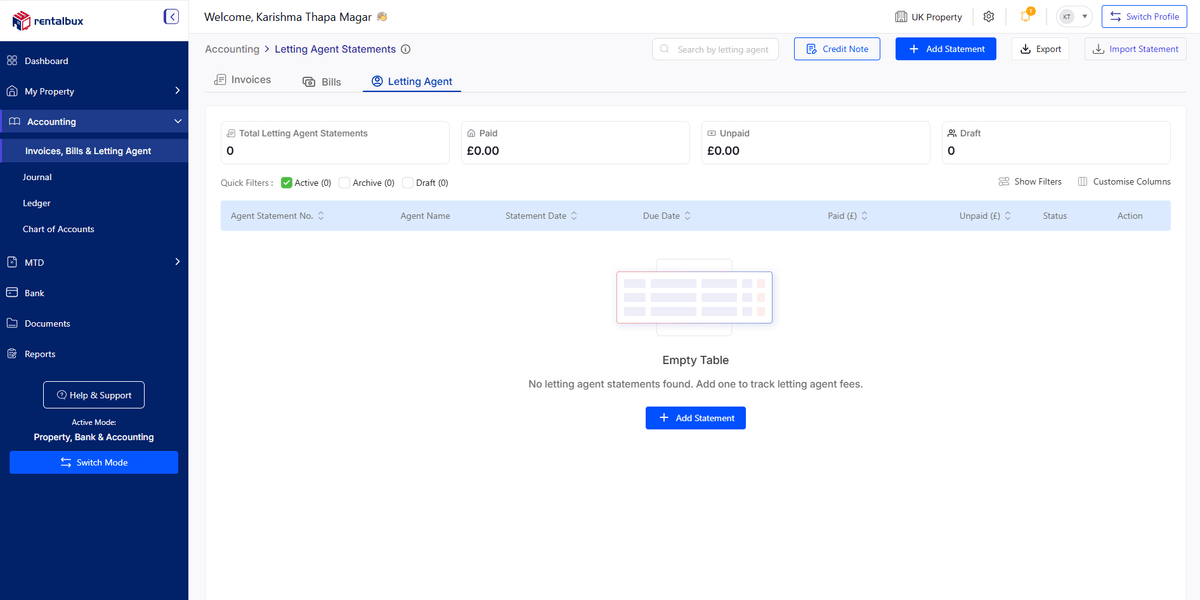
Option 1: Create a Statement Manually
Step 1 — Open the form. On the Letting Agents screen, click Create statement.
Step 2 — Fill in the statement details. Select the letting agent, then set the statement date, due date, and an optional reference. The statement number is assigned for you.
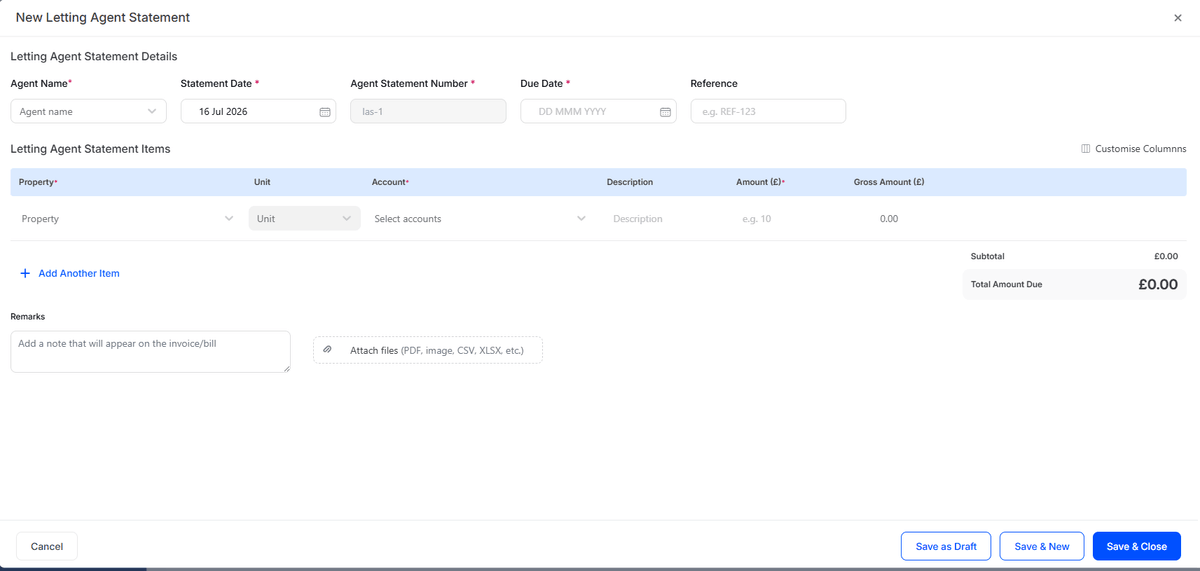
Step 3 — Turn on the non-resident toggle if it applies. If you are a non-resident landlord, switch on Non-resident landlord enabled and RentalBux applies the 20% withholding tax automatically on eligible income.
Step 4 — Select the property. Choose the property (and unit) the statement relates to. You can add more than one property to the same statement later.
Step 5 — Enter the rent as income. Under Rent Collected by Agent, pick the account, add a description, and enter the gross rent. Use Add line if the statement shows more than one rent line.
Step 6 — Enter each fee as a deduction. Under Fees & Deductions, add the commission on one line, then use Add deduction for the letting or renewal fee and any repair the agent paid. Each line maps to its own account.
Step 7 — Add more properties if needed. Click Add another property to record several properties on a single statement, each with its own rent and deductions.
Step 8 — Check the summary and save.
Option 2: Import the Statement
Step 1 — Start the import. On the Letting Agents screen, click Scan & import.
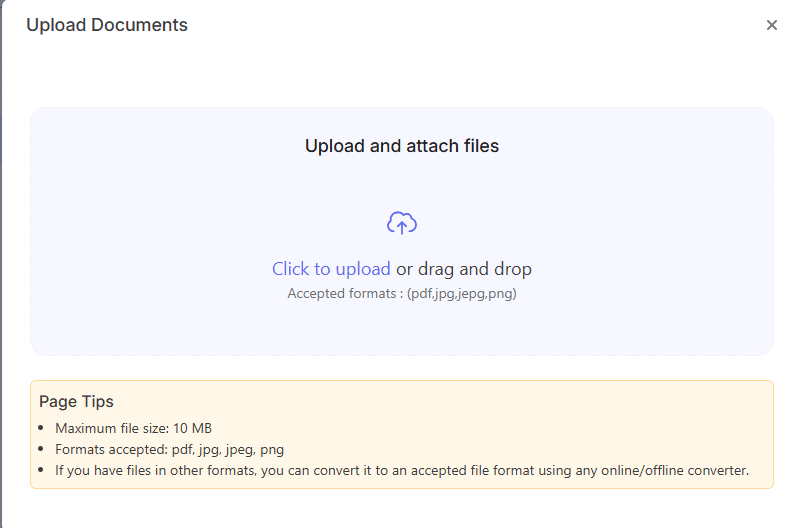
Step 2 — Add the file. Drag the agent's statement into the box, or browse to select it.
This keeps the agent's own statement on file as your source document, the record HMRC would expect to see behind your figures.
Conclusion
If your agent statements have been landing every month and you have only logged the net payment, your records are understating both your income and your expenses right now. The fix is not complicated, but it does mean going back to the statements and splitting each payment into gross rent in and fees out.
Done properly, letting agent statement record keeping gives you accurate quarterly updates, protects every expense claim, and leaves a clean trail back to the source document. Leaving it until year end turns a small monthly task into a scramble across a pile of statements.
FAQ Section
This guide is for general information only and does not constitute tax advice. Your circumstances may alter the outcome. Speak to a qualified adviser before acting.