.jpg&w=64&q=75)
.jpg)
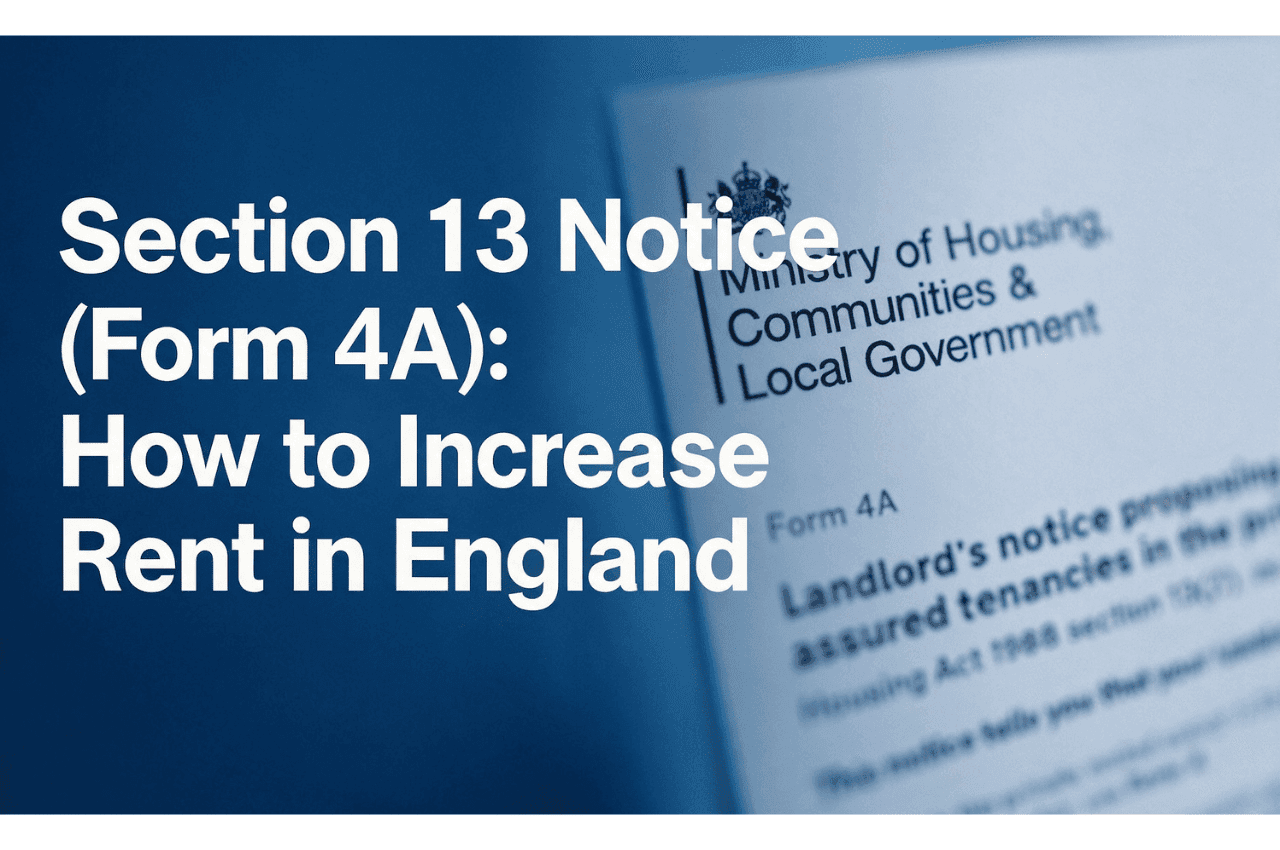
Planning a rent rise is easy to get wrong when the process has recently changed, and some methods landlords once relied on no longer work. This guide takes you through the legal route step by step: the paperwork, the timing, what a tenant can do if they disagree, and how to keep proof that you followed the process.
What Is a Section 13 Notice?
A Section 13 notice is the legal route used for rent increases in the ordinary private assured tenancies covered by this guide. An assured tenancy is a type of tenancy between a landlord and a tenant. It runs on a rolling basis, for example week by week or month by month, and cannot have a fixed end date.
The notice takes its name from section 13 of the Housing Act 1988, as amended. In plain terms, it is the formal written way of telling a tenant what new rent you propose and when it would start.
Does This Apply to Your Tenancy?
This guide is about ordinary private assured tenancies in England. Section 13 is not a procedure for the whole of the UK, and it is not a general rent increase method for every kind of residential letting.
Other situations follow different rules. These include homes in Wales, Scotland and Northern Ireland, and some other types of assured tenancy.
For example, relevant low-cost tenancies, including certain assured social housing tenancies provided by private registered providers, follow a separate rent increase procedure. Assured agricultural occupancies also have specific form and timing requirements.
If your letting is not an ordinary private assured tenancy in England, check the relevant GOV.UK guidance or take advice before relying on this guide.
What Changed on 1 May 2026 Under the Renters' Rights Act 2025?
The Renters' Rights Act 2025 changed the rules on rent increases from 1 May 2026. Two practical points matter most.
First, a rent review clause is a term in a tenancy agreement that lets the rent change at set times or by a set method. From 1 May 2026, an ordinary clause of this kind cannot be used to avoid the Section 13 procedure.
Second, do not assume that the tenant agreeing to a higher rent is enough on its own. Section 13(4A) of the Housing Act 1988 limits the ways in which rent can go up.
Which Form Do You Use? Form 4A
For the ordinary private assured tenancies covered by this guide, use Form 4A. Its full title is "Landlord's notice proposing a new rent for assured tenancies in the private rented sector". GOV.UK publishes it, and you should use the current version.
Note: Form 4 is a different form, used for certain social rented tenancies.
Completing Form 4A
Treat the GOV.UK form and its guidance as your instructions. Before you start:
download the current Form 4A from GOV.UK rather than reusing an old copy;
read the guidance that comes with the form;
complete the parts that apply to you, carefully;
check that the date you give for the new rent fits the notice and timing rules in the next section;
keep a copy of the completed notice.
How Much Notice, and When Can the New Rent Start?
You must give at least two months' notice, the new rent must start at the beginning of a tenancy period, and the first year and 52 and 53-week limits must also be met.
Notice Period
You must give at least two months' notice before the increase takes effect.
First Year
For an ordinary private assured tenancy, rent cannot normally be increased in the first year. The law sets this out as a 52-week rule.
Later Increases
Increases are generally limited to once a year. The legislation sets detailed 52- and 53-week timing rules, which decide the earliest date for each new increase. Do not rely on a rule of thumb here.
Start of a Tenancy Period
The new rent must also take effect at the beginning of a new period of the tenancy, for example at the start of a new weekly or monthly tenancy period.
Worked Example
Assume:
Tenancy start date: 10 June 2026
Tenancy period: Monthly, running from the 10th of each month
Current rent: £1,200 per month
Proposed rent: £1,300 per month
Form 4A served: 1 April 2027
Step 1: Check the First-Year Rule
The first rent increase cannot normally take effect within the first 52 weeks of the tenancy.
The tenancy started on 10 June 2026, so the increase cannot take effect before 10 June 2027.
Step 2: Check the Notice Period
The landlord must give at least two months' notice.
A notice served on 1 April 2027 gives more than two months' notice before 10 June 2027.
Step 3: Check the Tenancy Period
The new rent must take effect at the beginning of a new tenancy period.
Because the tenancy periods start on the 10th of each month, 10 June 2027 is a valid start date.
Result
The earliest date the new rent can take effect is 10 June 2027, provided the Form 4A is validly completed and served.
For any later increase, the landlord must also check the statutory 52- and 53-week timing rules before choosing the next increase date.
Rent Review Clauses and Notices Form Before 1 May 2026
This section deals with cases that began before 1 May 2026. Each is separate, so check which one applies to you.
A valid Form 4 served before 1 May 2026 |
|---|
If the landlord gave the tenant a valid Form 4 before 1 May 2026, the notice does not become invalid just because the proposed rent increase starts on or after 1 May 2026. The increase can still take effect on the date stated in the notice. If the tenant challenges that increase at the Tribunal, the Tribunal applies the rent increase rules that were in force before 1 May 2026. |
An increase under an old rent review clause that took effect before 1 May 2026: |
|---|
That increase still counts when working out when the landlord can next raise the rent. If the rent was increased under a contractual rent review clause before 1 May 2026, the landlord will generally have to wait at least 52 weeks from the date that increase took effect before a further Section 13 increase can take effect. |
An old rent review clause increase that was agreed before 1 May 2026 but was due to start after it. |
|---|
The increase does not take effect simply because it was agreed before the new rules started. If the proposed increase was due to begin on or after 1 May 2026, the landlord must instead follow the new Section 13 procedure, including serving the prescribed Form 4A and giving the required notice. |
How Much Can You Increase the Rent By?
Section 13 does not set a general percentage cap. The tenant can challenge the proposed rent and ask the First-tier Tribunal to decide the open market rent. In simple terms, that is the rent the property could be expected to achieve on the open market, worked out under rules in the legislation. It is not simply a matter of advertised rents or inflation.
This is practical advice, not a legal requirement: it helps to be able to explain how you reached your figure. For example, keep records of rents for similar properties and any improvements to the property. camelcase
What Happens if the Tenant Challenges the Increase at the First-tier Tribunal?
A tenant who disagrees can apply to the First-tier Tribunal. Three things are worth knowing:
The Tribunal decides the open market rent for the property.
For a Section 13 notice served under the new rules from 1 May 2026, the rent the Tribunal decides cannot be higher than the rent you proposed.
The Tribunal can also decide whether the notice itself is legally valid.
A tenant who wants to challenge the proposed increase must apply before the start date of the new rent stated in the notice.
Common Section 13 Notice Mistakes to Avoid
Using an out of date form, or the wrong one.
Giving less than two months' notice.
Increasing in the first year, or sooner than the timing rules allow.
Relying on a rent review clause or on the tenant's agreement alone.
Having no proof of how and when the notice was served.
Conclusion
A lawful rent rise comes down to a few habits. Use the current Form 4A, give at least two months' notice, check the timing rules before choosing a start date, and do not lean on an old clause or on agreement alone. Keep proof of how and when you served the notice.
If your tenant challenges the figure, the Tribunal cannot set a rent above your proposal, if the notice was served under the new rules from 1 May 2026.