


Managing gas safety checks across several rental properties can be difficult, particularly when each property has a different renewal date. But missing a required check is more than an administrative oversight. It can lead to criminal prosecution and, more importantly, leave tenants exposed to serious safety risks.
This guide covers the key safety deadlines landlords in England must track, how to align them across a portfolio, the new database requirements and the tax treatment of safety-related costs. For licensing, see our guide to selective licensing.
Landlord Safety Certificate Deadlines at a Glance
Check | How often | Done by | Tenant copy |
|---|---|---|---|
Gas safety (CP12) | Within 12 months of installation and every 12 months thereafter | Gas Safe registered engineer | Existing tenants within 28 days; new tenants before move-in |
EICR | At least every 5 years, or sooner if the report specifies | Qualified and competent person | Existing tenants within 28 days; new tenants before move-in; prospective tenants within 28 days of a request |
Smoke and CO alarms | Check working on the first day of each new tenancy; repair or replace faulty alarms as soon as reasonably practicable | Landlord or someone acting on their behalf | No formal certificate required; keep a record of checks |
Fire risk assessment | Review regularly and when circumstances change or the assessment may no longer be valid | Responsible person | Provide relevant fire-safety information to residents where required |
EPC | Valid for 10 years, unless replaced by a newer certificate; required when marketing or letting, subject to exemptions | Accredited energy assessor | Make available to prospective tenants at the earliest opportunity |
PRS database | Register within the applicable regional period; renew annually and update changes or expired information within 28 days | Landlord; an agent can help with specified updates | Not applicable |
Gas Safety Certificate Deadline: The 12-Month CP12 Cycle
The gas safety certificate deadline for a landlord is 12 months from the last check, for every gas appliance, fitting and flue you provide. A Gas Safe registered engineer must do the check, but the duty sits with you, and it applies in England, Wales and Scotland (GSIUR 1998, reg 36).
Renewing Early Without Losing Your Date (Regulation 36A)
Since April 2018, a check carried out in the two months before the deadline is treated as if it happened on the deadline date (HSE: gas safety records). It works like an MOT: you can book early without pulling your renewal date forward.
Worked Example
Event | Date | What happens |
|---|---|---|
Last gas safety check | 20/03/2026 | Next check due by 20/03/2027 |
Two-month window opens | 20/01/2027 | Any check from now keeps the 20 March date |
Engineer visits | 05/02/2027 | Treated as done on 20/03/2027 |
Next check due | 20/03/2028 | The anniversary date is unchanged |
A check completed on 10/01/2027, outside the two-month window, would normally bring the next deadline forward to 10/01/2028. Keep the previous and new gas safety records to demonstrate compliance with the checking schedule.
Copies, Records and Unsafe Appliances
Give existing tenants a copy within 28 days of the check and new tenants a copy before they move in (HSE). Keep each record until two further checks have been carried out.
If the engineer classes an appliance as "Immediately Dangerous" or "At Risk", treat it as an open action on your tracker until it is repaired and re-checked.
Failing to comply is a criminal offence. On conviction in the Crown Court, it can lead to an unlimited fine and up to two years' imprisonment (Health and Safety at Work etc. Act 1974, s33; HSE).
EICR Deadlines: The Five-Year Test and the 28-Day Rule
In England, the fixed electrical installation in a privately rented home must be inspected and tested by a qualified person at least every five years. If the report specifies a shorter interval, track that date instead.
What C1, C2 and FI Mean for Your Deadlines
C1 means danger present, C2 potentially dangerous and FI further investigation needed. C3 is only a recommendation.
Where the report requires remedial or further investigative work, the landlord must have it completed within 28 days of the inspection, or sooner if the report specifies. Written confirmation from the electrician must then reach the tenant and the local council within 28 days of the work being completed (GOV.UK guide for landlords).
Councils can impose a financial penalty of up to £40,000 for a breach (2020 Regulations, reg 11, as amended).
Fire Safety Certificate for Landlords: What the Law Actually Requires
There is no single "fire safety certificate" for a rented home in England. The duties are alarm rules for every tenancy, fire risk assessments for shared buildings and extra rules for HMOs.
Smoke and CO Alarms: A Day-One Duty, Not an Annual One
You must have at least one smoke alarm on every storey used as living accommodation. You also need a carbon monoxide alarm in any room used as living accommodation that contains a fixed combustion appliance, such as a boiler or wood burner. Gas cookers are excluded (GOV.UK alarm guidance).
The legal check is that each alarm works on the day a new tenancy begins, and that you repair or replace any alarm reported faulty. An annual test is good practice, not a legal deadline, so record the day-one test date and fault reports.
If you fail to comply with a council remedial notice, the council can impose a penalty of up to £5,000 (Smoke and Carbon Monoxide Alarm (England) Regulations 2015, regs 5–8, as amended).
Do You Need a Fire Risk Assessment?
Not for a self-contained house or flat occupied as a single private dwelling. The Fire Safety Order does not generally apply inside individual private dwellings. It does apply to the relevant common parts of blocks of flats and HMOs, such as shared hallways and stairs. In blocks of flats, the assessment must also consider the building's structure, external walls and flat entrance doors (Home Office guide).
Where it applies, the responsible person must review the assessment regularly and whenever circumstances change or the assessment may no longer be valid. There is no fixed statutory interval, so an annual review is a sensible trackable date. Holiday lets and other paying guest accommodation also fall under the Order.
Specified offences under the Fire Safety Order can lead to an unlimited fine and/or up to two years' imprisonment on conviction on indictment (Article 32).
Extra Duties for HMOs
HMO landlords and managers have additional fire-safety duties under the Management of Houses in Multiple Occupation (England) Regulations 2006. These include keeping escape routes clear and maintaining fire alarms and firefighting equipment in good working order.
Licensed HMOs may also have additional conditions imposed by the local council. Add each relevant licence condition, such as a specified alarm inspection or servicing requirement, to your tracker as a separate task. Check your property's actual licence rather than assuming every council applies the same conditions. Some conditions apply to every licensed HMO, including producing a gas safety certificate to the council each year and keeping a working smoke alarm on each storey used as living accommodation (Housing Act 2004, Schedule 4).
EPCs: When an Expired Certificate Matters
An EPC is valid for 10 years, but it does not need renewing just because it expires during a tenancy. You need a valid EPC when you market or let the property. If the certificate has lapsed since the current tenancy began, you do not have to replace it until you next market or let that home.
EPC C From 1 October 2030
The current minimum is band E, unless a valid exemption is registered. The government has confirmed that privately rented homes in England and Wales must meet EPC C, or have a registered exemption, from 01/10/2030 (GOV.UK, November 2026). A home rated C under the current method before 01/10/2029 counts as compliant until that EPC expires or is replaced.
Failing to provide an EPC generally carries a £200 penalty for a domestic property (Energy Performance of Buildings (England and Wales) Regulations 2012, reg 38). Letting below the minimum standard can lead to penalties of up to £5,000 per property.
The PRS Database: A Second Deadline After Every Renewal
From 15/12/2026, landlords in England must register themselves and each relevant let property on the new Private Rented Sector database, as the service rolls out region by region. You must provide evidence of the property's gas and electrical safety certificates and keep these details current. If a certificate expires or other registered information changes, you must update the record within 28 days. The annual fee is £65 per property, with a pro-rata charge during the initial rollout (GOV.UK announcement; NRLA summary of the PRS Database Regulations 2026).
Regional Registration Deadlines
Registration opens on 15/12/2026, but the requirement starts region by region, with three months to register. The deadline depends on where each property is located, not where the landlord lives. Properties in the West Midlands must be registered by 14/03/2027, those in London by 14/10/2027 and those in the South West, the last region, by 14/11/2027.
Landlords can register properties early from 15/12/2026, even if their region’s registration period has not started. There is no bulk-upload option, so larger portfolios should plan ahead and allow time to enter each property. Organisations can use the service’s multi-user functionality to share registration tasks.
What Safety Details You Must Enter
For each property you will need the date of the most recent gas safety record, a current EICR or EIC and its expiry date, and the latest EPC details. If the EPC has expired, you give the start date of the current tenancy instead.
The 28-Day Update Rule
Once registered, you must update your landlord and property entries within 28 days whenever information or documents become out of date. Renewing a gas safety certificate or EICR counts as a change.
Failing to meet specified database requirements, including the duty to update records, can lead to a civil penalty of up to £7,000 once the relevant enforcement provisions are in force.
Joint landlords share one property entry, but each must have their own landlord entry. You must start the registration yourself and remain legally responsible for compliance. However, letting agents and property managers can provide and update specified property information on your behalf.
See our Renters' Rights Act guide for the wider changes.
How to Build a Portfolio Compliance Calendar
The aim is to group visits into fewer, larger windows: fewer call-outs, fewer access requests and fewer chances to miss a deadline.
Worked Example: Five Properties, Two Visit Windows
A landlord has five gas properties with renewal dates spread across the year. They choose two visit windows: February to March and September.
Property | Gas check due | Visit date | Inside 2-month window? | Next due |
|---|---|---|---|---|
1. Terraced house | 15/03/2027 | 10/02/2027 | Yes | 15/03/2028 |
2. Flat | 30/04/2027 | 05/03/2027 | Yes | 30/04/2028 |
3. Semi-detached house | 20/06/2027 | 12/03/2027 | No | 12/03/2028 |
4. Maisonette | 25/09/2027 | 15/09/2027 | Yes | 25/09/2028 |
5. Flat | 10/11/2027 | 20/09/2027 | Yes | 10/11/2028 |
Property 3 loses just over three months of certificate life because its check takes place outside the two-month early-check window. From then on, three properties can be serviced in the February–March window and two in September.
Where an EICR is also due, coordinate it with the same visit if you can arrange a suitably qualified electrical inspector.
Set reminders 60 days before each visit window to book appointments and 30 days before to confirm tenant access. After each check, diary two separate 28-day follow-ups: sending the tenant their safety record and, once the requirement applies, updating the PRS Database. Track any EICR remedial work separately, as it has its own deadline.
When a Tenant Will Not Let You In
You have a legal defence if you can show you took all reasonable steps to comply (HSE; GSIUR reg 39). Build the evidence as you go.
Give written notice with a proposed date, write again if access is refused, and keep every letter, message and missed-visit note. Keep trying after the deadline: the evidence protects you but does not end the duty.
How Safety Costs Are Treated for Tax
Most routine safety and compliance costs are allowable expenses against rental income because they are incurred wholly and exclusively for the letting business (ITTOIA 2005, ss34 and 272). Capital expenditure, such as improvements that go beyond repairs or the purchase of new assets, is generally not deductible against rental income.
Routine gas safety checks, EICRs, EPC assessments and fire risk assessment fees are normally revenue costs. The £65 annual PRS Database fee is also tax-deductible, as confirmed in the Government's landlord registration guidance.
Repair or Improvement?
Remedial work that restores something to its previous condition is a repair. HMRC's examples include replacing a broken-down boiler. Adding something that was not there before is capital, and is not deductible against rental income (GOV.UK: work out your rental income). Replacing an old part with its nearest modern equivalent is still a repair.
Replacing a Condemned Appliance
If an engineer condemns a freestanding gas cooker or fridge you supply, the like-for-like replacement may qualify for replacement of domestic items relief (ITTOIA 2005 s311A). The relief does not cover the first purchase of an item, and any upgrade element is disallowed. A fitted boiler is part of the building, so its like-for-like replacement is a repair instead.
Worked Example: How Safety Costs Are Treated
Cost | Amount | Likely treatment |
|---|---|---|
Annual gas safety check | £90 | Revenue expense |
EICR | £200 | Revenue expense |
C2 remedial: replace cracked sockets and a faulty light fitting | £240 | Repair, revenue expense |
Condemned freestanding gas cooker replaced like-for-like | £450 | Replacement of domestic items relief, subject to conditions |
New mains-wired interlinked alarm system where only battery alarms existed | £600 | Potential capital improvement; treatment depends on the nature and extent of the upgrade |
Keeping the Records
Landlords within Making Tax Digital for Income Tax must use compatible software to create and store a digital record of each expense, including its amount, date and category. Their software then groups expenses by category and includes the totals in their quarterly updates to HMRC. Individual receipts and transaction details are not sent as part of those updates.
Wales and Scotland: What Changes
Gas safety rules are the same across Great Britain, and the PRS Database applies to England only.
In Wales, landlords must have a valid electrical condition report at all times, based on an inspection at least every five years or sooner if the report specifies. At least one smoke alarm on each storey must be connected to the property's electrical supply, with all mains-connected smoke alarms linked together. Carbon monoxide alarms are also required in rooms containing gas, oil-fired or solid-fuel appliances (Wales Regulations 2022).
In Scotland, landlords must arrange an EICR and checks of landlord-provided electrical appliances at least every five years, or sooner if the inspector recommends it. Fire detection requirements include smoke alarms in the main living room and circulation spaces on each storey, plus a heat alarm in every kitchen. All alarms must be interlinked, but they can be mains-powered or tamper-proof, long-life lithium battery models (Repairing Standard guidance).
If you let properties in more than one UK nation, maintain a separate safety checklist for each. This helps you keep track of different legal requirements and avoid missing a regional obligation.
How RentalBux Helps With Safety Compliance Records
RentalBux works as a compliance tracker for your whole portfolio. You record each safety certificate against the property it belongs to, and the software shows at a glance which certificates are valid, which are about to expire and which have already lapsed.
Every Safety Certificate Stored Against the Right Property
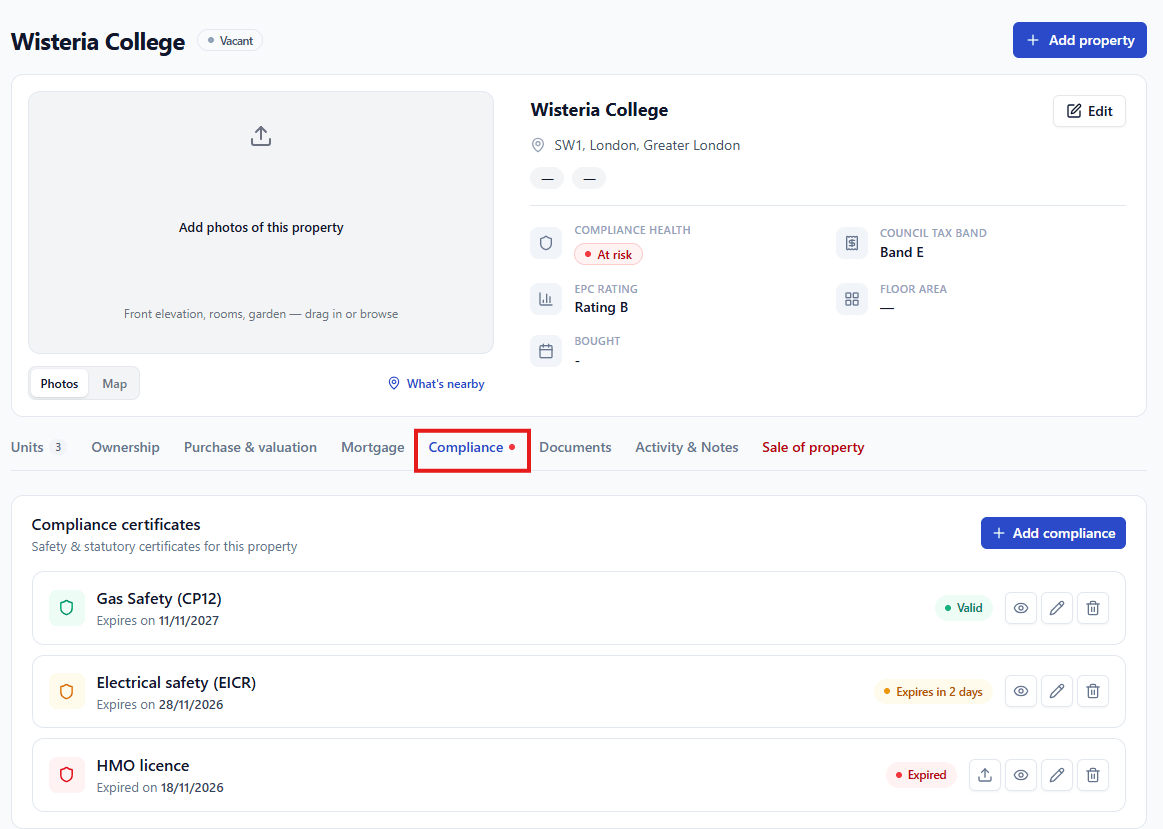
Each property in RentalBux has its own Compliance certificates section, so every certificate sits with the home it covers. You can record all the main safety and statutory certificates a landlord needs to track:
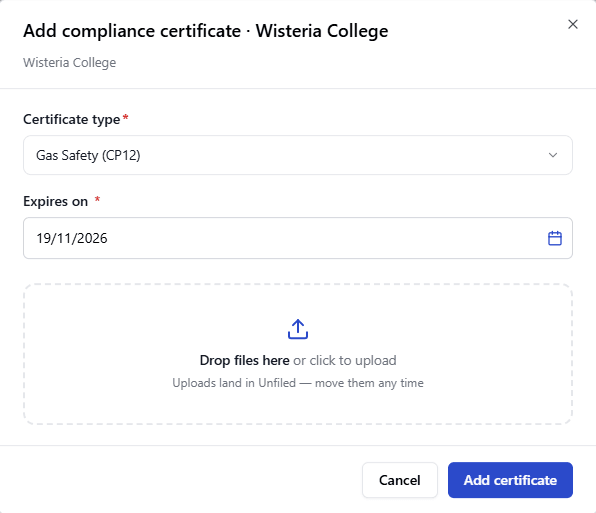
Gas Safety (CP12)
Electrical safety (EICR)
Energy Performance Certificate (EPC)
HMO licence
Fire risk assessment
Legionella assessment
PAT testing
Each certificate is saved with its expiry date. Instead of searching through emails and paper files, you can see every property's compliance records in one place.
Expiry Status and Reminders at a Glance
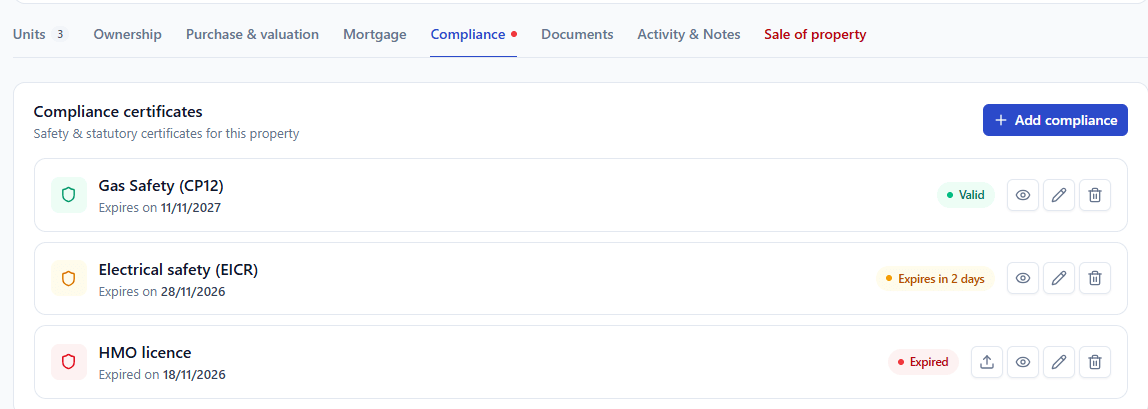
RentalBux gives every certificate a colour-coded status based on its expiry date:
Valid (green): the certificate is in date.
Expires in X days (amber): the deadline is close, so it is time to book the engineer or electrician.
Expired (red): the certificate has lapsed and needs urgent action.
RentalBux also sends reminders as certificates approach expiry, so renewal dates across your portfolio do not depend on memory or a paper diary. You can view, edit or delete any certificate record from the same screen.
When you renew a certificate, update its expiry date in RentalBux straight away. Remember that the PRS Database needs updating separately within 28 days.
Conclusion
Four key requirements drive much of landlord safety compliance in England: the 12-month gas safety check, the five-year EICR interval, the day-one alarm test at the start of each new tenancy and, from December 2026, the 28-day PRS Database update after relevant information changes or expires.
Track every requirement per property, use the two-month gas-check window to group visits and keep certificates, invoices and payment records organised. This makes it easier to demonstrate compliance, manage renewal dates and support your rental expense claims for tax.


