



The Renters Rights Act UK represents one of the most significant overhauls of residential tenancy law in recent decades. The legislation fundamentally reshapes the legal framework governing the private rented sector in England, introducing extensive reforms designed to strengthen tenant protections whilst establishing new obligations and accountability mechanisms for landlords.
This article provides a detailed examination of the key provisions within the Renters Rights Act UK, analysing their practical implications for landlords, tenants and professional advisers operating within the sector.
11 Key Points form Renters Rights Act UK
Abolition of Assured Shorthold Tenancies and No-Fault Evictions - Renters Rights Act UK removes assured shorthold tenancies and Section 21 evictions, requiring all new tenancies to be periodic and landlords to rely on statutory grounds to regain possession.
Stringent Rent Increase Controls - Rent can only be increased once every 12 months, with a minimum of two months' notice, and tenants may challenge excessive increases to the First-tier Tribunal.
Prohibition of Advance Rent Payments - Renters Rights Act UK prohibits landlords from requiring rent in advance, except for the initial rent period, thereby removing financial barriers for tenants.
Right to Request Permission to Keep Pets - Tenants have the right to request permission to keep pets, which landlords cannot unreasonably refuse, ending blanket pet bans.
Mandatory Written Tenancy Terms - Landlords must provide written statements of tenancy terms and prescribed information before the tenancy commences.
Private Rented Sector Database - All landlords must register themselves and their properties on a public database before marketing or letting, with unique identifiers required in all advertisements.
Mandatory Landlord Redress Schemes - All residential landlords are required to join approved redress schemes that investigate tenant complaints and make binding determinations.
Prohibition of Discrimination - It is unlawful for landlords to refuse tenancies based on family status or receipt of social security benefits.
Decent Homes Standard - Renters Rights Act UK establishes minimum property condition standards for the private rented sector, with local authorities empowered to enforce compliance.
Enhanced Enforcement Powers - Local housing authorities may impose financial penalties ranging from £1,000 to £40,000 for breaches, with rent repayment orders extended to a maximum of two years.
Protection from Retaliation for Repairs Requests and Poor Conditions - Landlords can no longer evict tenants for complaining about poor conditions or requesting repairs, as the Decent Homes Standard and Awaab's Law establish minimum property condition requirements and mandatory repair timescales for serious hazards.
The Renters Rights Act UK addresses longstanding concerns about security of tenure, rent increases, discrimination and enforcement within the private rental market. By abolishing assured shorthold tenancies and establishing assured tenancies as the standard form of residential letting, the legislation marks a decisive shift towards greater stability for tenants.
Alongside these core reforms, the Act introduces a Private Rented Sector Database, mandatory landlord redress schemes and enhanced enforcement powers for local housing authorities.
Abolition of Assured Shorthold Tenancies
The most prominent reform introduced by the Renters Rights Act UK is the complete abolition of assured shorthold tenancies. Under the Housing Act 1988, assured shorthold tenancies became the dominant form of residential tenancy, offering landlords a straightforward route to possession after the expiry of a fixed term or upon serving notice. This mechanism provided landlords with flexibility but afforded tenants limited security beyond the initial term.
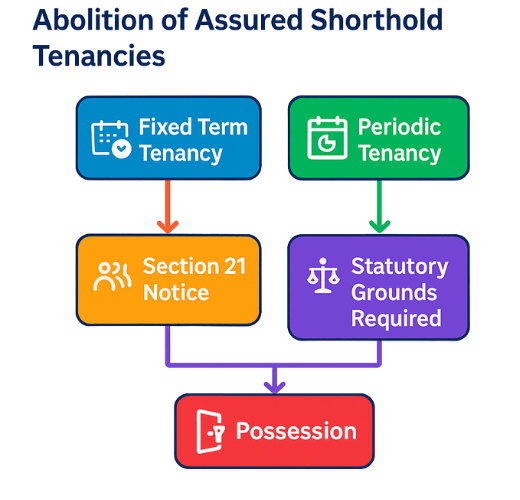
Renters Rights Act UK removes this structure entirely. All new tenancies falling within the scope of assured tenancies will now operate under the assured tenancy regime, without the ability to revert to assured shorthold status.
This change eliminates the automatic right to possession that landlords previously enjoyed under Section 21 of the Housing Act 1988, requiring landlords to rely exclusively on statutory grounds for possession as set out in the amended Schedule 2.
Transition to Periodic Tenancies
A further fundamental change is the mandatory conversion of all assured tenancies to periodic tenancies. Renters Rights Act UK prohibits the granting of fixed-term assured tenancies, requiring that all new assured tenancies operate periodically with rent periods not exceeding one month.
Tenants will typically pay rent either monthly or every 28 days, providing consistency and removing the uncertainty associated with transitioning from a fixed-term to a statutory periodic tenancy.
This shift aims to create greater flexibility for tenants who may need to end a tenancy without being tied to a fixed contractual term. It also seeks to eliminate the practice of landlords using successive fixed-term leases to avoid providing long-term security.
However, the change will require landlords to adapt their lettings practices, particularly in relation to rent collection and property management cycles.
Controls on Rent Increases
Renters Rights Act UK introduces stringent controls over rent increases for assured tenancies. Rent may only be increased in accordance with a statutory procedure, and landlords are prohibited from increasing rent to a level exceeding the previous rent unless the increase is agreed between the parties or determined by the First-tier Tribunal.
Tenants must receive clear notice of any proposed rent increase, and the tribunal retains discretion to determine whether the proposed increase is reasonable, having regard to comparable properties in the area.
The prohibition on advance rent payments, save for the initial rent at the commencement of the tenancy, further protects tenants from financial strain. This measure is intended to prevent landlords from requiring substantial upfront payments that may create barriers to access or financial hardship for tenants.
Tenant Rights Regarding Pets
Renters Rights Act UK introduces an implied term into all assured tenancies, granting tenants the right to request permission to keep a pet. Landlords retain the right to refuse such requests, but must do so in a reasonable manner.
Where a tenant makes a request, the landlord is required to respond in writing within 28 days, either granting or refusing permission and providing reasons for any refusal. If the landlord requires further information about the pet before making a decision, an extension of time may be permitted.
This provision represents a significant change for landlords who may previously have imposed blanket prohibitions on pets. The requirement to act reasonably necessitates a case-by-case assessment, taking into account factors such as the type and size of the pet, the nature of the property, and any potential impact on neighbours or the landlord's obligations under the lease.
Landlord Obligations and Written Terms
Renters Rights Act UK imposes a duty on landlords to provide tenants with a written statement of the tenancy terms before the tenancy commences. This statement must include details of the rent, the rights and obligations of both parties and other prescribed information. The aim is to ensure transparency and reduce the potential for disputes arising from unclear or unwritten terms.
Landlords must also ensure that properties meet health and safety standards; tenants are entitled to seek compensation if these standards are breached. Local housing authorities are granted enhanced enforcement powers, including the ability to impose financial penalties of up to £7,000 for non-compliance with the Act's requirements.
Grounds for Possession
The Schedule to the Renters Rights Act UK sets out the amended grounds for possession, which now represent the exclusive means by which landlords may recover possession of properties let under assured tenancies.
The grounds include both mandatory and discretionary grounds, covering scenarios such as rent arrears, anti-social behaviour, breach of tenancy obligations and situations where the landlord requires the property for their own occupation or for sale.

New grounds have been introduced to address specific circumstances, including possession for agricultural workers, student accommodation, supported accommodation and properties subject to enforcement action. Landlords will need to ensure that they comply strictly with the procedural requirements for each ground, as failure to do so may result in possession proceedings being struck out or delayed.
Exclusions from Assured Tenancy Status
Renters Rights Act UK clarifies the categories of tenancies that fall outside the definition of assured tenancies. Long-term tenancies exceeding 21 years are excluded, as are tenancies granted for terms between 7 and 21 years where these were entered into before the commencement of the Act or within a two-month grace period thereafter.
Tenancies forming part of regulated home purchase plans are also excluded, aligning the treatment of these arrangements with financial services regulation.
Student accommodation provided by educational institutions and temporary accommodation for homeless persons continue to be excluded from the assured tenancy regime. These exclusions recognise the distinct nature of such arrangements and the specific regulatory frameworks that apply to them.
The Secretary of State retains the power to amend the categories of excluded tenancies by regulation, providing flexibility to respond to evolving housing practices.
Prohibition of Discrimination in the Rental Market
One of the most socially significant reforms introduced by the Renters Rights Act UK is the prohibition on discrimination based on family status and receipt of benefits. It is now unlawful for landlords or their agents to refuse to grant a tenancy to a prospective tenant on the basis that the tenant has children or may have children living with them or visiting them. Similarly, landlords cannot discriminate against prospective tenants because they receive social security benefits.
Not Allowed
Refuse tenants with children
Reject applicants who receive social securitybenefits
Apply blanket bans on families or claimants
Any term in a tenancy agreement that purports to prohibit children or benefits claimants from occupying the property is rendered void and unenforceable. This provision addresses longstanding concerns about discriminatory practices within the rental market, which have disproportionately affected families and individuals reliant on welfare support.
Enforcement of these provisions is undertaken by local housing authorities, which may impose financial penalties on landlords found to have engaged in discriminatory conduct. The penalties are intended to act as a deterrent and to reinforce the principle that access to housing should not be restricted based on protected characteristics.
The Private Rented Sector Database
Renters Rights Act UK establishes a Private Rented Sector Database, which will contain information on residential landlords, dwellings let under residential tenancies and individuals subject to banning orders, convictions or financial penalties. The database will be operated by the Secretary of State or by an appointed operator, and landlords will be required to register both themselves and their properties before marketing them for letting.
Each landlord and dwelling will be allocated a unique identifier, which must be included in all written advertisements for the property. It will be unlawful to market or let a dwelling unless there is an active entry for both the landlord and the property in the database. This requirement is intended to enhance transparency and enable enforcement authorities to identify non-compliant landlords more easily.
The database will also include entries relating to individuals who have been subject to banning orders or who have been convicted of offences related to the management of residential property. Local housing authorities will be required to make entries in the database where such orders or convictions have been recorded. This information will be accessible to enforcement authorities and, in certain circumstances, to the public, thereby promoting accountability within the sector.
Landlords will be required to keep their database entries up to date, with regulations outlining the process for updating information and the circumstances under which entries may become inactive. Failure to maintain an active entry or to provide accurate information may result in financial penalties of up to £7,000, with higher fines of up to £40,000 for more serious breaches.
Landlord Redress Schemes
Renters Rights Act UK requires all residential landlords to be members of an approved landlord redress scheme. These schemes provide a mechanism for tenants to raise complaints about their landlords and seek redress when landlords fail to meet their obligations. The schemes will be administered by independent bodies approved by the Secretary of State, ensuring that complaints are handled impartially and in accordance with prescribed standards.
Landlords who fail to join an approved redress scheme will be subject to financial penalties, and enforcement authorities will have powers to compel membership. Decisions made by redress scheme administrators will be binding on landlords, although landlords may seek to challenge decisions through the courts in limited circumstances.
The redress schemes will have the power to award compensation to tenants and to require landlords to take remedial action. It may include requiring repairs to be carried out, returning unlawfully retained deposits or ceasing particular practices that breach the tenancy agreement or statutory requirements. The schemes will also be required to publish information about complaints received and outcomes achieved, promoting transparency and enabling tenants to make informed decisions about prospective landlords.
Rent and Rent Increases
The provisions governing rent and rent increases are central to the Act's objective of enhancing tenant security. As noted above, rent may only be increased in accordance with the statutory procedure set out in the Renters Rights Act UK. Landlords must serve a prescribed notice on the tenant, specifying the proposed new rent and the date from which it will take effect. The notice period will be prescribed by regulation, but must provide tenants with adequate time to consider the proposal and to seek advice if necessary.
Tenants who consider that a proposed rent increase is excessive may refer the matter to the First-tier Tribunal. The tribunal will determine the appropriate rent having regard to the rents payable for comparable properties in the locality, the condition and amenities of the property and any other relevant factors. The tribunal's decision is binding on both parties, and the rent as determined by the tribunal will take effect from the date specified in the landlord's notice unless the tribunal directs otherwise.
The prohibition on advance rent payments, other than the initial rent, prevents landlords from requiring tenants to pay rent covering extended periods in advance. This measure is designed to reduce financial barriers to accessing tenancies and to prevent landlords from circumventing the rent increase controls by requiring large upfront payments.
Transitional Provisions
The Renters Rights Act UK includes comprehensive transitional provisions to manage the shift from the previous legal framework to the new regime. Existing assured shorthold tenancies will be converted to assured tenancies upon the commencement of the relevant provisions, although certain transitional protections apply.
Where a landlord has served a Section 21 notice under the Housing Act 1988 before the commencement date, the notice will remain valid for possession proceedings commenced within the prescribed period. It ensures that landlords who have taken steps to recover possession in reliance on the existing law are not unfairly prejudiced by the change.
Fixed-term tenancies in existence at the commencement date will continue until the expiry of the fixed term, at which point they will become periodic tenancies under the new framework. Rent increases agreed or determined before the commencement date will remain valid, and tenants will not be able to challenge them retrospectively under the new provisions.
The transitional provisions also address the treatment of tenancy deposits, tenant fees and information requirements. Landlords will be required to provide tenants with written information about the changes introduced by the Act within one month of commencement, ensuring that tenants are aware of their enhanced rights and protections.
Practical Implications for Landlords and Tenants
For Landlords
The Renters Rights Act UK imposes significant new obligations on landlords and curtails many of the flexibilities that existed under the previous regime. Landlords will need to familiarise themselves with the amended grounds for possession and ensure that they comply strictly with procedural requirements when seeking to recover possession. The removal of Section 21 possession proceedings means that landlords will no longer have the option of regaining possession without establishing a statutory ground for doing so.
Registration on the Private Rented Sector Database and membership of a landlord redress scheme will be mandatory. Landlords will need to ensure that their entries remain active and up-to-date. The requirement to include unique identifiers in all advertisements will necessitate changes to marketing practices.
The controls on rent increases will require landlords to adopt a more transparent approach to rent setting, and landlords will need to be prepared to justify proposed increases if challenged by tenants. The prohibition on advance rent payments may have cash flow implications, particularly for landlords who have historically relied on such payments to cover void periods or to mitigate risk.
The prohibition on discrimination based on family status and receipt of benefits will require landlords to reconsider any blanket policies that may have been applied in the past. Landlords will need to assess prospective tenants on a case-by-case basis, taking into account their ability to meet the rent and comply with the tenancy obligations, rather than excluding categories of tenants outright.
For Tenants
The Renters Rights Act UK provides tenants with significantly enhanced security of tenure and greater protection against unfair practices. The abolition of assured shorthold tenancies means that tenants can no longer be evicted without grounds simply because a fixed term has expired or a Section 21 notice has been served. Tenants will benefit from clearer rent increase procedures and will have the right to challenge increases that they consider excessive.
The right to request permission to keep a pet, the requirement for landlords to provide written terms and the protections against discrimination all contribute to a more balanced relationship between landlord and tenant. Tenants who experience problems with their landlord will have access to redress schemes, providing an accessible and cost-effective means of resolving disputes without the need for court proceedings.
However, tenants should be aware that the removal of fixed-term tenancies means they will also be required to give notice if they wish to end the tenancy, rather than being able to vacate at the end of the fixed term. The notice period will be specified in the tenancy agreement or by statute, and tenants must ensure compliance with these requirements to avoid liability for rent beyond the date of their vacating.
Explore expert insights and stay informed with our: Renters’ Rights Act 2025 resources.
Advisers working in the property sector will need to ensure that they are fully conversant with the new legislative framework. The changes affect not only the substantive rights and obligations of landlords and tenants but also the procedural requirements for possession proceedings, rent referrals and enforcement actions.
Advisers should be particularly alert to the transitional provisions, which contain detailed rules governing the application of the new law to existing tenancies. Misunderstanding these provisions could lead to incorrect advice being given, with potentially significant consequences for clients.
The enhanced enforcement powers and the introduction of financial penalties mean that compliance will be a key focus for landlords in the future. Advisers should be proactive in ensuring that landlord clients are aware of their obligations and take steps to comply before enforcement action is taken.
Conclusion
The Renters' Rights Act 2025 represents a fundamental recalibration of the legal framework governing the private rented sector. By abolishing assured shorthold tenancies, introducing mandatory periodic tenancies, strengthening controls on rent increases and establishing new accountability mechanisms through the Private Rented Sector Database and landlord redress schemes, the Act seeks to create a fairer and more transparent rental market.
The legislation will undoubtedly present challenges for landlords, who will need to adapt their practices to comply with the new requirements and to operate within a more tightly regulated environment. However, the reforms are intended to address longstanding imbalances in the rental market and to provide tenants with greater security and protection.
For professional advisers, the Act requires a thorough understanding of the new provisions and a careful application of the transitional rules. As the legislation comes into force and guidance and case law develop, advisers will need to remain alert to emerging issues and to provide clients with accurate and practical advice that reflects the changed legal landscape.
The success of the Act will ultimately depend on effective implementation and enforcement. Local housing authorities will need to be adequately resourced to carry out their expanded functions, and landlords and tenants will require support in understanding their rights and responsibilities under the new regime. If these conditions are met, the Renters' Rights Act has the potential to deliver meaningful improvements to the security and quality of life for millions of tenants across England.

